Friday, March 28, 2008

Easter Week


Holy Week and the Triduum was a marvelous experience for our Saint Patrick's community. I was unable to make it to Maundy Thursday observances because of a work commitment, but we shared that liturgy with Apostles' Church at their meetingplace. On Friday we had a joint Tenebrae service with South Elkhorn Christian Church. The liturgy was well done, and SECC has some friendly folks.

I was very pleased with our Easter Vigil; I'd spent a great deal of time practicing to chant the Exultet, and by the time I finished it, I thought I was going to pass out by the end of it, but happily I remembered to bend my knees a bit halfway through the 6 minute song. Here's an excerpt:
This is the night
when Jesus Christ broke the chains of death
and rose triumphant from the grave.

What good would life have been to us,
had Christ not come as our Redeemer?
Father, how wonderful your care for us!
How boundless your merciful love!
To ransom a slave you gave away your Son.

O happy fault,
O necessary sin of Adam,
which gained for us so great a Redeemer!


Most blessed of all nights,
chosen by God to see Christ rising from the dead!
I was honored and even humbled to lead our people into the Easter Vigil and celebration in this way. I spent part of Holy Week listening to Kallistos Ware's lectures on the meaning of the cross (scroll down the page for links), and one of hte things that occurred to me as I practiced is that many protestant Christians are - how can I put this - inappropriately sorry for the death of Christ. I've read some devotions regarding the execution of the Lord that speak as if it were entirely a terrible, terrible things, and really it would have been better if the whole thing could have been avoided. This is not true, of course, for the death of Christ was an extravagant act of love by God. We thank the God who so wonderously created, and more wonderously redeemed>!

This is a Western hymn, so I do find some of the theology a bit problematic. The song reads, "
For Christ has ransomed us with his blood,
and paid for us the price of Adam's sin to our eternal Father!"

As Bishop Kallistos puts it, it is biblical to say that Christ paid the ransom, but we must remember that this is a concept that only goes so far. We can not take it so far as to say what the Scripture does not, i.e. that Christ paid the ransom to the devil, or that Christ paid the ransom to God, because neither was really "holding us for ransom." Rather, the emphasis is on the healing and freeing work of Christ: it is as if we were slaves, and Christ laid down payment to purchase us for himself.

To say that Christ paid the ransom to the devil brings us a place of theologizing about "the devil's rights" over humanity before God. That is deeply, deeply problematic, and it is an error made by some patristic writers (apparently) and many Pentecostals (obviously). To say that God was enslaving us and that he needed a ransom paid to himself does two problematic things: 1) it presents God as capricious and evil, because in such a conception it becomes God who keeps us enslaved to sin and death. 2) It places a wedge between Christ and the Father, and the redemptive work of Christ is depicted as something that he performs over against the Father. That's a problem. This is a mistake that some patristic writers made (apparently) and many Baptists make (obviously).

Is that enough for today? I think it is.

Saturday, March 22, 2008

Holy Saturday


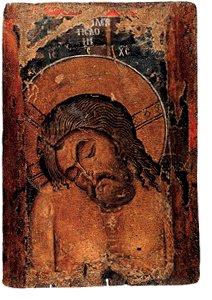
Christ in the Tomb

A Prayer for Holy Saturday

O faithful, come, let us behold our Life laid in a tomb to give life to those who dwell in tombs. Come, let us behold him in his sleep and cry out to him with the voice of the prophets: 'You are like a lion. Who shall arouse you, O King? Rise by your own power, O you who have given yourself up for us, O Lover of mankind.'

We await the Great Vigil.

Wednesday, March 12, 2008

On Choosing a Church

I read a wonderful bit of wisdom on Amy Welborn's blog today. Marcel Lejeune shared this on a comment thread:
A friend recently asked me what I “need from the Church”. My response boiled down to - I need the Church to make saints. Not in naming someone a saint, but rather in calling us all to holiness and perfection. Making modern-day saints out of the ordinary. We have a crisis in holiness in the Church. Holiness would solve every problem.
There is a great temptation to think about the work of the Church (caring, healing, celebrating and teaching) as equivalent to some kind of service industry or retail job. At the bookstore, I want the place, and particularly my religion section, to be the kind of place to which people will want to come and spend time and buy books. There is a needful and legitimate extent to which I have to think about what people want, and try to have that on offer. It's my job to sell books, and other concerns are secondary. I do have the opportunity to serve in some creative ways: there are a number of books in Joseph-Beth's selection that I make sure we carry, and do indeed sell, that you're not going to find in other places, and that we wouldn't have if I didn't put them there. If you want them, you will come into the shop and find good Christian books that are good for you. It will not be hard to find them. This is not true at chain stores or Christian bookstores (depending, of course, on who you trust to declare something "good.") Of course, you will also find Joel Osteen's stuff. I work for a "secular" business, not a confessional one. I don't go out of my way to get book that I think are bad for people just because I think they'll sell. But I don't try to prevent the stocking of titles that already sell. And of course if I'm indifferent about a title, I want to carry it if it will sell.

The work of the Church ought not to follow the same logic, however. "Give the people what they want" is a sound business practice and marketing strategy, but it is deadly to the life of any church that seeks to organize itself in such a fashion. The shape of the liturgy is not decided by popular vote, and we must not be interested in doing things because they are "neat." The Church has a reason to exist that comes before anybody else's agenda: it is the People of God, the new humanity that has been created in Jesus Christ to worship the Father along with Him, and to participate in the renewal of Creation in the power of the Spirit.

The Church doesn't exist in order to bring a large number to its Sunday gatherings for any reason, or to be "useful" in the social order or to split up responsibilities for poor folks with the government. The Church is called to give people Christ through the Sacraments, and Christ through their own presence in the dark and broken places of human life. The Church is called to mimic and extend Jesus' own ministry of healing, teaching, meal sharing and exorcism. That can look like all kinds of things, but the Church is not at liberty to make up activities unrelated to those things, and call it "ministry."

This is why it is dangerous to choose which group of Christians you'll make your life with on the basis of musical tastes, your "enjoyment" of the "worship experience," or the activities they put on offer. In most cases, those things will have very little to do with whether you can find healing and wholeness in Jesus Christ along with that community, or whether they are a people who can or will come alongside you to stay in the dark places of your life.

We need to be involved in communities that will participate actively in God's work of making us all saints - bringing us all to completion of who we really are.

Wednesday, March 05, 2008

Christian Worship Lingo

I had a good conversation with a friend yesterday about the teaching implicit in different liturgical styles. For example, in some churches, the "worship band" is illumined by stage lights in an otherwise dark auditorium. In the context of Christian worship, the implication is that the band are objects of veneration.

Seriously. Otherwise, why would it be important to see them? This is improper, and you should all stop it at once.

In other congregations, however, the worship band/music team/whathaveyou doesn't have a script. They don't talk. The entire congregation has a script it follows as it learns to talk to God the Father along with Jesus, who is the real "lead worshipper."

And of course, when my own parish meets in a place with fancy lights, we illumine the altar, because that is the dramatic focus of the entire movement. And yes, you may venerate it if you wish.

Saturday, February 16, 2008

Just for fun

Of course, sometime in the next 5 years, I'm thinking about planting a new Anglican parish in Georgetown, Kentucky, to bring the Catholic religion to that poor benighted land. Now, you may be aware that it is traditional for protestant groups to name their communities after numbers, or the streets along which the meetinghouse sits, or something that shows good marketing sense while resonating with the language of Scripture (e.g. "New Hope" or "Living Water, and so on). The Catholic churches (Rome, Canterbury, and the East) will often name their communities for notable saints, or events in the life of Christ. While there's not a hard and fast rule, many hardcore Anglo-Catholic churches will pick the latter option. For example, Church of the Advent in Boston is so "high up the candle" that the local Roman Catholic Archbishop gets a nosebleed when he passes on the street.

While I might have fled to the Church of the Holy Hierarchical Authoritarianism, I've got enough tra-la-la tree-hugging namby-pamby egalitarianism in me that I'd probably go in and start the "Georgetown Anglican Fellowship," and then when we numbered around a dozen, start discerning an appropriate name/patron/commemoration for the parish. But just for fun, here are my top five name choices for a new parish I'd like to start, somewhat in order.

  1. Saint Clement of Rome. We have one document extant from this early leader of the Roman Church, his Epistle to the Corinthians in which he lovingly chides them for their disunity. The community had recently overthrown their college of presbyters and apparently brought in some upstarts to replace them. I've written on the Epistle here. I believe that American Anglicanism has an ecumenical and unifying mission in the life of the Church as it seeks to live and share the Gospel, and looking to Clement and his writing as an example would be good for a young parish.

  2. Saint Mary Magdalene. Mary is known for her loving dedication to the Christ who exercised and healed her of demonic oppression. In a neurotic, materialistic suburban culture, we need this model. Also, this is the name of a famously exuberant Anglo-Catholic parish in Oxford. Which is braggable. Heh.

  3. Church of the Resurrection. This really shouldn't need any explanation at all. We need Jesus Christ, the second Adam, to heal us and make us alive.

  4. Saint Cyprian of Carthage. Haha, not really. I just wanted to see who was paying attention.

  5. Church of the Incarnation. Take that, latent gnosticism! Meditation on the Incarnation will guide us to sacramental and catholic imagination, to understand that matter can and does bear the glory of God.
What do you think?

Monday, February 11, 2008

Why Ecclesiology is a Rough Subject

As soon as one decides that the nature of the Church is a first-order rather than a second order question (see here), things begin to get very difficult. One can no longer say that the constitution, identity and practices of different Christian communities amount to a matter of preference. If one believes that one's life in the Christian community (what kind of life, and what kind of community) will impact the nature or extent of one's connectedness to Jesus, then comments like, "I go to x church because I like the music and you go to y church because you like the education program ceases to make any sense. Preferences, no matter how fastidious or well-meaning they are, are not the reason for the Church's existence.

For better or worse, I always need a reason.

I find that when I am no long prepared to speak about preferences as a theological category, I quickly have to start pinning down what the concrete attributes are of those concrete communities that are connected to those communities started by Jesus. As I work these things out, I find a two-edged sword.

1) If I really get hardcore about this, I'll have to face up to the real and potential inadequacies of my own (adopted) tradition. The Roman, Eastern Orthodox, and Reformed Christian traditions all have particular criticisms of what Anglicanism would seek to be, even at its best. I have to do business with those criticisms, and I might well find my "spiritual home" lacking.

2) In the same way, if I were to write about this journey, I would have to admit the ways in which I believe other Christian traditions to be lacking. I've not often been shy about this, but I don't believe that it's necessarily an edifying discussion to have. Surprise, even the folks to look to me for encouragement or challenge in the Faith (in this space or otherwise) are not eagerly awaiting any pronouncements on which churches are real churches. I'd probably end up sounding like the Pope, but with different conclusions, i.e., the requirements for being understood as fully and properly "the Church" are ABCD, and while it's nice that you've got BCDE over there, if you don't have A, you're Christians but don't experience the life of the Church in its fullness. I suspect the Holy Father and I would just pick different letters.

I might talk about what I think those letters consist of later on, or I might not. We'll see.

Wednesday, February 06, 2008

Lenten Antics

Kitty is covered in soot and hissing at his bowl of kibble.

He hates fast days.

Sex in the Church: A Glossary

The rhetoric of the culture wars has made it increasingly clear that many Christians and Christian denominations lack a theology of marriage. Just pick up the paper or turn on the television, and you can uncover all kinds of contradictory rationales as to how marriage ought or ought not be defined - and indeed, who should define it. I remember when George W. Bush announced to the nation that "marriage is a sacrament;" I wondered if he was making the statement in his capacity as the President of the United States, or as a United Methodist layman.

Amusingly, many Christians don't know how to talk about not having sex, either. With this in mind, I'm going to draw out the meaning of three distinct words that are often used interchangeably in Christian circles: abstinence, chastity and celibacy.

Abstinence is the state of refraining from sexual relations. Some people are abstinent by choice, and others by commitment - it's a very broad and general word. This is not the same as chastity or celibacy. Married people might practice abstinence during a period of fasting, or single people who are dating but not "hooking up" could be called abstinent. It's the answer to a yes or no question, and is not indicative of an overall lifestyle choice, while the other words are.

Chastity is a Christian virtue. Those who are chaste engage in sexual relationships only within the boundaries offered by a Christian moral vision. For married people, that means they only engage in sexual relations with one another. For those who are not married, this means not engaging in sexual congress at all. Chastity is a Christian obligation for all baptized persons, whether they are single or married.

Celibacy is a vowed state, as marriage is a vowed state. An unmarried Christian person who practices abstinence is not considered celibate - rather, they are chaste. Vowed or not, in a Christian context celibates are people who have closed the door to the possibility of marriage in response to a call from God. Therefore, while a chaste single Christian might go on a date, a celibate Christian would not. Celibacy and marriage are like bookends in the life of the Church. They are alternative states of life that are protected by vows to which Christians seek to be faithful.

Does that clear some things up?

Tuesday, February 05, 2008

Beginning Great Lent

This is my standard introduction to the practices of the Christian season of Lent.

I realize that not all of my wonderful readers are familiar with the purpose and practice of the Lenten season. Stay with me as I indulge myself (and perhaps you) in a little bit of history and theology.

Where it Came From

In the earliest Christian centuries, once the Christian mission moved past Palestine and the "god-fearing" Gentiles (those familiar with and disposed toward the story of Israel's god, like Cornelius in Acts 10) and into the wider Roman world, it became necessary to catechize potential converts - to be intentional about teaching them the story of Israel's god, his people, his world, and his Christ, from beginning to end. Catechesis was a time of ethical reformation, as members of the church discipled these soon-to-be Christians in the way of God's New Community.

Much of the theological instruction for this one to three year period was put into the period of 40 days before the Great Vigil of Easter. The forty days brings echoes of Moses conversing with God on Sinai before receiving the Ten Commandments, the forty years of temptation in the wilderness that refined Israel, and the forty days when Jesus entered the wilderness for his communion with God and to prepare for his own testing. Forty days is a time of refining and of being with the Lord.

At the season of Lent, Christian converts receive intensive theological education, accompanied by prayers, confession and exorcisms - it is indeed an intense time of being with the Lord. The rest of the Church also walks through this time of penitence and learning and self-examination.

Walking with Jesus

It also has a place in the overall narrative of Jesus' life: At Epiphany, we commemorated his appearance to his people, and realized that he is the light that scatters our darkness. At his baptism, he was revealed to be the Son of God, bearing divine favor for the people. At the reception of John's baptism, he identified himself with the faithful remnant of Israel, and began to reconstitute the nation in terms of loyalty to himself by his calling of the Twelve; now enter the story of the last days of his ministry, when he begin to orient himself and his disciples to his vocation of suffering and death for the sake of the people. The story has taken a dark turn, and we join the Master as he sets his face resolutely toward Jerusalem. In solidarity with him, we begin the time of sorrowing for our sins and his suffering, walking into the darkness of our broken humanity in the hope of Easter's light.

So the matter of Lenten disciplines or practices is this: what can I do to set my own face toward Jerusalem? What in my personality and my life with the Church in the world needs to be put to death, and what does God wish to be raised up? I think we find the answers to these questions by putting ourselves in an intentional posture of listening: making a quiet space in our routines to hear from the Lord.

This is not meant for Herculean efforts of spiritual zeal - like boot camp for Jesus - but for a time of greater intentionality. We learn to be quiet and make space, preparing for the conviction of sin, and to offer our brokenness for his healing, so that when we do speak and act, we will do so as a grateful and repentant response to the Trinitarian God who leads us into truth.

We rededicate ourselves in practical ways to prayer, to seeking and listening to the counsel of our brothers and sisters, and in learning more deeply the Way of Life. In this practice-able, regular actions - these ways of making space - we invite the Lord to purge our personalities of the dross of the old nature, and to refine us more and more as part of the new creation. Repentance, it must be remembered, is a change of attitude, a new way of seeing that sends us walking in a different direction. Sometimes the turning is slight, and sometimes it's one hundred and eighty degrees. Our goal is not a particular spiritual experience or to start or stop a particular habit necessarily, but to be with the Lord and offer to him our readiness to turn in unexpected directions, to listen to words we would not have anticipated, and answer yes to him in ways we would not have imagined.

The time of Great Lent is upon us. May it be a holy one as we walk into the dark places of ourselves and discover that the Lord Himself leads us into the stillness of our solitary fears, to sit with us, to heal us, and to absorb all of our darkness into the Darkness of his Cross and the Light of Easter Dawn.

So how do we make this concrete?

Saying the office is a way of making space in our day that will sanctify the rest of it, and letting the Scriptures teach us how to offer our hearts to the Lord.

Centering prayer enables us to quiet ourselves in a deep, purposeful way, to stop the noise and stop the thinking and just stop … and wait for the Spirit of the Lord to come and do what it will. It's about giving him space to do the deep works he needs to do, but doesn't really need to tell us about.

Attending to the holy mysteries, and receiving the mystical body of Christ into oneself - does that need explanation? Salvation, after all, isn't only or even mostly in our heads. Salvation is performed, and salvation must be eaten.

Peace and blessing be upon you as you begin the journey of Lent in God's Church.

Monday, January 28, 2008

Still Thinking About the Church

We've just passed the Week of Prayer for Christian Unity. I wanted to write, but really felt as if I have nothing to contribute to such a thing. I've been thinking and reading on the subject of ecclesiology for some time now (more thinking than reading lately), and it always seems to be a very divisive subject.

I have no use for Christians who take deep pride in their particular spiritual pedigree or denomination. In this region that pride is often in the form of their supposed lack of a "denomination." "I'm a non-denominational Christian," many will say gleefully - as if that were possible or desirable. Perhaps it is, but I cannot treat it as such a foregone conclusion.

Why even think about "ecclesiology" - what makes the churches "the Church" at all? If a Christian shares perspective with most forms of Protestantism, there is little reason indeed. In contemporary Christian life, it is commonly agreed that Jesus did not "found" any church at all, and that our churches are our own little man-made organizations that try to carry out the work of spreading the gospel and converting the heathen more efficient. I know this sounds glib, but that's what it comes down to: that the church exists because it is useful to our version of the Gospel (which we believe to be a separate thing from the church) simply because Jesus wants his people to "meet together."

On the other hand, what if Jesus didn't come to impart some information about God and a revised moral code? What if he didn't come with a way for us to have an individual personal relationship with God that we could practice with other people if we wanted to? What if Jesus really did found a community that really did have a real and physical existence in the world? What if being joined to Jesus through baptism and being joined to this real physical community really is the same thing, the same Godward movement that makes us alive and saves us from death?

Upon Christian initiation, one becomes part of Christ - in Pauline language, the Body of Christ. While I understand that one should avoid an ultimate identification of Christ and those who make up the Church (it is full of sinners, after all, for Jesus loves the riff-raff), we must say that if Jesus founded a "community of salvation," that an impaired communion with that Church entails an impaired communion with Christ himself. If that is a worthy question and a valid concern, our ideas about what makes up "the Church" really matter very much.

The bottom line is this: if the bedrock of the Christian life and God's work of transforming love in the world is a "personal relationship with Jesus," then theories about "the Church" are non-essential issues. However, if our membership in that community determines in some way our relatedness to God and his work of salvation for the world, than it is a first-order theological problem.

Ta Da!

I am now one of 5600 Americans without a credit card.

Tuesday, January 15, 2008

It always surprises me

... how many people imagine that publishers will sell $7.99 Mass Market paperback versions of the hot new thriller at the same time that they release the $25.98 hardcover.

I don't think they realize that publishers and writers and marketing staff and booksellers do it to make a living; it's not some kind of hobby everyone does for fun, this book-writing stuff.

It's always a strange moment when an old woman complains even as she pays me for her books that Amazon is so much cheaper. I considered telling the last one that since no, Amazon does not and would not offer any discount on her three mass market paperbacks, she was in truth saving on shipping. Most of you people probably don't read those, and I only own 4 in my entire library,* but now you know. I'd rather pay more and not get ink on my hands, but then again I'm not sitting in a dark room alone counting my pennies all night, either.

(I usually ignore things that old unpleasant customers say. One quickly learns that there is no good or right answer, if by "right," we mean, will make the bitter old woman happy. She is, after all, buying old woman pornography for a reason.)

I'm cleaning the house today. Probably.

*Susan Howatch's Glittering Images, an old copy of Catch-22, A Farewell to Arms, and The Moviegoer by Percy.

Thursday, January 10, 2008

Stuff

I overheard Father Matthews saying something before Mass last week about "shedding the rags of popery." Right when the little vein in my forehead started throbbing, I realized that he know I was standing behind him.

Just because I'm spastic doesn't mean it's okay for the other kids to tease me like that.

Our monastery cat, Thunder, is stuck in the back of my desk chair again. He has really sharp, long claws, and they look very regal. He likes to climb up my chair, or attack our ratty old sofa sometimes. The problem is that he gets stuck, and cannot extricate his regal little claws from his large and unwieldy prey. It's pretty funny.

The cat just knocked over my little idol statue of Saint Patrick again. Okay, so maybe he's not the best monastery cat. But he is otherwise very pious. (We have little competitions.)

I just got back from Waffle House with my co-workers. Too much fun.

Wednesday, January 02, 2008

Marriage and Hypocrisy

I was just looking over the October 2007 issue of Christianity Today this evening (I've been busy, as you know) and was really struck by an article that called for better ministry to "stepfamilies." The point of the article is that instead of passing judgement upon divorced and remarried persons, churches should simply accept that everyone makes mistakes and welcome them into full fellowship.

I've heard of that before: it's called "welcoming and affirming," but it's usually applied to something just a little bit different.
"In many cases, divorce is indefensible, bringing serious consequences to adults and children. It should not be taken lightly. Yet to deny somone full forgiveness and the right to live life to the fullest in Jesus Christ denies the healing power of the Cross."
Denying the Christian legitimacy of a divorce and remarriage is a denial of the healing power of the cross? That's a stunning accusation. There's not a single nod in the article to the idea that Christian discipleship requires some basic decisions for self-denial.

Ron Deal's article, "Redeeming the Remarried" is a nearly identical to most arguments for churches celebrating same-sex unions. One of the really fun things about talking with evangelical Christians who are in favor of serial monogamy is that by the time they offer all of their conditions and caveats, they've left the door wide open in their theological house for the legitimation of same-sex unions.

Of course I also watch people go in one of two ways with this (if they don't ignore it altogether): 1) since we're obviously not going to be so draconian as to turn back the clock on our practices of divorce and remarriage, we should bless same sex unions, or 2) maybe if we're going to claim a theology of marriage, perhaps we should have one and quit legitimating the notion that everybody gets to define the meaning and boundaries of their own relationships with no real reference to the Christian tradition.

Option 1 would at least be honest, and option 2 would be a miracle.

Tuesday, December 11, 2007

Question

If john piper can have 'christian hedonism,' can i have Christian sadomasochism?

Oh yah, and I'm home now. (In case you hadn't heard the angels singing)

I am so bloody tired.