Showing posts with label homilies. Show all posts

Wednesday, September 24, 2008

Daily Wages in the Kingdom of God

The meditations that follow are adapted from the homily I preached at Mass last week. It is the normal practice in my tradition for a congregation to hear a set of readings appointed for the day. This schedule of readings, or lectionary, helps ensure that the teaching of the Faith in a local parish is based upon a broad selection of Scripture. In each passage, the character of the Christian God is demonstrated to stand over against normal standards of fairness.

The Old Testament (Hebrew Bible) reading comes from Jonah 3.10-4.11, one of the “minor” prophetic books in the OT. This book is unusual for the literature in that it recounts the prophet’s story rather than his prophecy.

God sent Jonah to Nineveh, that great heathen city and enemy of Israel, to warn of God’s impending judgment upon their immorality. Jonah was more than a little reluctant, and he ran as far as he could, but finally submitted to the prophetic call and preached to that alien people.

Jonah’s mission was a success, and he was furious.

Perhaps he feared his reputation as a prophet – after all, if you threaten fire from the sky upon the city brothels, but everyone gets a soft rain on their sackcloth, it’s a good indication that either the prophet is a crackpot, or that the prophet’s God is merciful and loving. Jonah is likely more concerned for his own reputation than that of the Lord – to say nothing of all the time and energy he wasted. I know that if I were going to a strange land to make threats in public, I’d want to see a much bigger body count. It doesn’t help either that, in general, good news for big pagan cities was bad news for little Israel.

God, for his part, seems quite upset that Jonah has not seen fit to emulate God’s attitude toward the roaring pagans of Nineveh. It almost seems like he spits his words at the Lord, as beautiful words of praise are intended as a stinging rebuke “…I knew you are a gracious God and merciful, slow to anger, and abounding in steadfast love, and ready to relent from punishing.” If God is so capricious, so shallow and fickle, thinks Jonah, as to take the pious playacting of the pagans as evidence of real repentance, let him kill Jonah now, because that makes for a pretty untrustworthy God. Jonah, you understand, was being something of a drama queen.

But the Lord grows a plant to shade the fuming Jonah from the heat of the sun. And then he kills it. Jonah rails against God, renewing his righteous indignation against an arbitrary deity. God continues his Socratic questioning: “You care about a plant. You care about the plant because you find it useful. Those people and those animals – they’re not doing me any good at all, but I care very much for them. The cows, Jonah! I think about the cows. Which one of us is really arbitrary? Which one of us really cannot be trusted to be faithful?

Today’s words from Paul in 1:21-27 in his Letter to the Philippians offer a stark contrast to Jonah’s resentment. Whereas Jonah suffered because of his rejection of God’s love for the undeserving, Paul suffers because of his willingness to preach the good news about Jesus, the world’s true Lord, to even the Imperial Household! Jonah despaired of death because he despised the mercy of the Lord, finding it unfair and by his own standards, arbitrary. Paul, however, was a man transformed by God’s mercy through Jesus Christ and was so grateful for this that he was pleased to spend himself to share that experience with others. Paul welcomed death because of his real suffering, and Jonah’s suffering stemmed only from his choice of ingratitude.

In our gospel reading, Jesus offers us a parable of economics in the Kingdom of God – the Kingdom of which Caesar’s empire is only a parody. In biblical literature, vineyard workers usually signify the people of God living and working according to God’s rule in the land of Israel. In our story, God is represented as a vineyard owner who pays only fairly to those who work all day, and is much more than fair to those who come around later: he gives them all the same wages. Jesus’ story would have had particular resonance for somebody like Paul. Though as a Jew, his people – the first vineyard workers – were included first in God’s Kingdom project. Gentiles were hired later, as it were.

Paul himself was a latecomer to the Movement. He had persecuted the fledgling Church with vigor, and having received forgiveness was eager to proclaim the same grace to a pagan people that didn’t know the God of Israel. We could safely say that at least one purpose in the Matthean context was to place Jewish and Gentile believers on equal footing.

Attempts at contemporary application for the parable can be murky, however. One popular interpretation of the parable reads it in the context of conversion and the Final Judgment, arguing that it demonstrates full validity for the last-minute, deathbed conversions of raucous sinners. Without directly challenging the time-honored practice of snatching sick sinners right from the very maw of eternal hell, I will argue that we cannot use the parable for this purpose. First, such an interpretation that offers equal eschatological rewards for unequal efforts directly contradicts the previous paragraph in Matthew in which Jesus states that everybody’s going to get paid back a hundredfold for everything they left behind for the Kingdom. Second, I’m reluctant to consider this a parable of judgment, because when Jesus tells those, he’s usually alluding to his own rejection and God’s vindication: in Jesus’ parables of judgment, the owner usually comes home and burns the vineyard and kills the wicked servants. This parable is not presented as a parable of judgment, but an illustration of everyday life under God’s reign: this is what the Kingdom of God is like. After all, a denarius is a daily wage, and a subsistence wage at that. That doesn’t sound like a hundredfold return to me, or much of a “final reward.” It’s more than an little out of place to represent eschatological judgment in this fashion: “Oh, you’ve come to the restoration of heaven and earth. Here’s a days’ worth of food; do try to make it last.”

So as we put aside the usual interpretations, how do we hear this story? As Kingdom people – a community that lives presently under God’s Reign, we “tend the vineyard” by living according to his rule and carry out his Mission. Cyril of Alexandria offers his reading:
“He gives to all ‘their single denarius,’ which is the grace of the Spirit, perfecting the saints in conformity with God and impressing the heavenly stamp on their souls and leading them to life and immortality.”
As we do this work, each of us is offered the same necessary grace and supply of the Spirit for faithful work.

Some of us are “early hires” in the work of the Lord. We show hospitality. We teach to any who would listen, the Christian message of God’s reign established in Christ. We are faithful to study the Scriptures, pray the Office, work the disciplines and cultivate a life of forgiveness toward our friends and blessings for our enemies. We have spent years learning to dedicate ourselves to holiness and the work of God in his world. People like us can be easily tempted to think like Jonah and the other early hires of whom Jesus spoke: ready to say how and when and why God should show generosity to others. We can be quick to consider our accolades, awards, degrees, reputations, and expect that a good God will make sure everything is fairly apportioned.

This is Jesus’ call to his faithful ones: “Set aside your symbols of accomplishment, and let go of your comparisons to others. Step away from each talisman of security and worth, and really trust me. Trust that I love you. Trust that even while I delight in your faithfulness, I don’t love you because of it. Trust that I simply love you.” We always begin to lose our way when we imagine that we can earn or deepen the love of God.

Some of us might think of ourselves as “late hires.” Perhaps we’ve only met Jesus late on our lives, or only recently began to get serious about discipleship. Maybe we’re not seriously dedicated to the Kingdom yet at all! Some of us come from alternative religious traditions in which we were told lies about God, and so we’re more than happy to keep Jesus at arm’s length for awhile. Maybe we stand at the far end of a lot of years or an entire life in which we didn’t do anything that we meant to, and find hopes and our dreams for our selves, our families, our religion and our careers to be dashed upon a rock. Nobody’s going to pick us first for kickball, vineyard tending or dog catching. Some of us strive after those accolades and degrees, looking for a rationale to talk other people into loving us, and to talk Jesus into saying we’re good enough. We desperately need to believe that Jesus really does love us and will love us and will heal us regardless of our accomplishments, because we just don’t have very many of those.

Here is good news: he offers all of us the same grace, and the same hope of transformation, whether we are 18 or 80, faithful or failing. Jesus is our host. He invites us all to the same table to get what we so desperately need: to eat his flesh and drink his blood in these holy mysteries, and to receive the supply of the Spirit in order to amend our lives and to carry on the work of his Kingdom. “Come to me, all you who are weak, and carry a heavy burden. I will place my yolk upon your shoulders, and you will find rest for your souls.”

Holiness is not a function of what we avoid, or even the good works we perform. Christian holiness means that we belong to Jesus, and seek to grow in love. We progress in that life by confessing our failings and confessing our trust in the one who can and will do a good work in us for the sake of his love. One of the most urgent questions in the life of the ancient Christian churches was how to understand the reality of the Church’s holiness through its mystical union with Jesus Christ as well as the reality of its members’ sinfulness. Some argued that the Church could only be holy if its members always maintained their moral purity, always resisted sin, and never denied the Lord through their words or actions. All of those who fall short after baptism must be put out. Saint Augustine maintained that such a stance placed the Church over against the teaching of Jesus, who entreated us daily to ask forgiveness for our sins – we would do poorly to prefer our perfectionism over Jesus’ merciful realism. [1]

Christians do not grow in holiness because they avoid everything that’s bad for them, and make all of the right choices. If this were true, we’d simultaneously be growing in pride. It’s not about checking off all the right boxes and obeying all the rules. Holiness comes through ongoing exposure to truth – the truth about ourselves and the truth about Jesus Christ. As the Lord and the Christian Community reveal our sins to us, we confess them and place our trust in the forgiveness and generous mercy of Jesus Christ. We are made holy through our receptivity to the truth, and our admission of our own need for healing and forgiveness, and continual trust in God to restore us.

Last week the Church commemorated one of her martyrs, a pastor named Cyprian. Cyprian was made bishop of the Church at Carthage in the year 250, just in time for a short but vicious persecution of Christians at the hands of the Empire. In the face of torture, exile, and loss of property, many Christians kept the faith, and refused to deny Christ. Some lived and some died. Others gave into the pressure of the persecution and denied the Lord. When the persecution ended, there was great controversy over the fate of the lapsed who wished to rejoin the Christian community. Rigorists insisted that the lapsed had committed the sin against the Holy Spirit in denying the Lord, and should not be re-admitted to the community. Cyprian was one of the bishops who insisted upon modeling the Lord’s mercy, and maintained that He welcomed all who repented and turned again. The lapsed were required to undergo a long period of penance before admission to the Lord’s table – a period of fasting and spiritual disciplines, in order that they would be strong enough to confess the Holy Name.

AD257 saw a new persecution in North Africa, at which point Cyprian re-admitted all of the lapsed to the table of the Lord. He entreated other bishops to do the same, for reasons he describes in a letter to the Bishop of Rome:
“…Now peace is necessary, not for the sick, but for the strong…. And, as the Eucharist is appointed a safeguard to those who receive, we need it in order to arm, with the protection of the Lord’s abundance, those whom we wish to be safe against the adversary. For how do we teach or provoke them to shed their blood in confession of his Name, if we deny to those who are about to enter warfare the Blood of Christ? How do we make them fit for the cup of martyrdom, if we do not first admit them to drink, in the Church, the cup of the Lord by right of Communion?”
Jesus Christ and his Church call us to be faithful workers in the vineyard by cultivating holiness and growing in faithfulness to mission. In baptism, we receive a work of grace by which we no longer belong to ourselves, but to Jesus Christ and one another. In this initiation sacrament there is spiritual power as we are made alive in Jesus to stand against sin and death, both in our own lives and the culture around us. In the sacrament of Holy Communion we receive “the medicine of immortality” by which we overcome fear, addiction, selfishness, and all the snares of the evil one. In study of the Scriptures, we learn the truth that sets us free from all the lies we may have believed about God and ourselves. Steps of obedience in the life of the Christian community and faithful study of the Christian tradition will teach us to walk with integrity and wisdom, and to be more faithful to our identity in Christ.

All of this, of course, leads us on in mission as we seek to be vineyard workers faithful to the vision of the vineyard owner. We have been sent to speak and enact an alternative story of love and forgiveness in the midst of a people who are determined that everybody should have just what they deserve. We are a people who will bless our enemies, pray for those who use us, and lavish forgiveness on those who want to hurt us. We will offer people what they need regardless of what they deserve: a relationship with Jesus Christ and a place in his new humanity.

So draw near to God by making faithful and honest confession of your faults. Come to the table praying forgiveness for those who have wronged you, and blessing for those you can’t stand. Come and share mystical communion with the risen Lord by eating his flesh and drinking his blood. Receive power to be Jesus People.

In the name of the Father, and of the Son, and of the Holy Spirit. Amen.

[1] This paragraph is adapted from a great discussion in the second chapter of Rowan Williams, Why Study the Past? The Quest for the Historical Church, Eerdmans, 2005.

Thursday, April 13, 2006

Simon Peter's Maundy Thursday Homily

Maundy Thursday


Okay kids, here's the promised homily: a narration from the perspective of Simon Peter.

Download the mp3 here (1.1 Mbs) or read the text here.

The scripture reference is here, if you're not familiar with the story.

Other good thoughts at
Coming to the Quiet
Monastic Mumblings

And some complaining at The Archer of the Forest.

Tuesday, March 21, 2006

Weakness and Power

3 Lent

From the conclusion of my homily:
I suggest to you that this inversion of wisdom and foolishness and power and weakness means that we can stop trying to be “wise,” or to win “signs” from God. We can cease trying so desperately to be spiritual, and trying not to be thick. Power is found in joining ourselves to the salvation that Christ has accomplished. It is not spiritual victories or warm fuzzies or a feeling of “excitement for the Lord” that makes us safe in Christ. Christ alone makes us safe in Christ. We already find ourselves in the temple of the Living God, encountering the thin place where the boundaries between heaven and earth disappear. We are called to join ourselves to the rhythm of the liturgy, welcoming into our lives the ongoing presence of the salvation that was worked out in another place two thousand years ago.

We are freed from our searches for wisdom, those fool-proof, fail-safe, forty day or ten step plans that promise to make life with Jesus finally “work” for us. No more measuring spiritual growth: “getting results” will not bring us home from exile. Rather, we must open our eyes and see that we have already been carried home. It is our inability to make discipleship work and our willingness to be with him in all of our self-recriminations that we can begin to understand ourselves as recipients of grace. We must understand this, as people who join Christ in making up the temple of God: our need and destitution do not drive God away, but necessitate God’s presence. It is safe for us to be fools. It is safe for us to be failures. We have just remembered a long story of promise, failure, apostasy and hope. The truth is that God’s faithfulness is always so much more than our strengths and weaknesses. Whatever we lack, our gracious Master has supplied. He has given us his own life to eat and drink, that by our participation in him, we die and are raised up anew.
Technorati Tags: ,

Wednesday, April 07, 2004

Maundy Thursday 2004

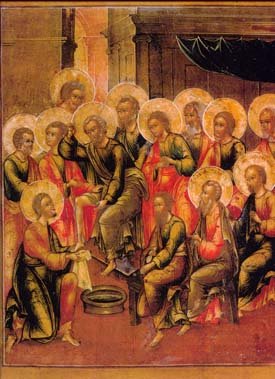
I've been gifted to preach at the footwashing tomorrow, so I wrote this dramatic monologue in lieu of a traditional sermon. +Dallas was even kind enough to lend his crozier for a prop!

(You can listen to the audio version here)

Maundy Thursday, 2004

It is good to be with you. My name is Simon Peter. I lead the community here in Rome. We tell a lot of stories this time of year, to remember the death and new life of our King. We tell stories to learn who we are.

When we celebrate the Passover meal, we remember that we were created by God’s saving act. We who were slaves became a nation when Yahweh moved his mighty arm and delivered us from the hand of Pharaoh hundreds of years ago. We became his special people all over again thirty years ago when our Master Jesus became the Passover for us and by his resurrecton saved us from the darkness of sin. Many of you who were not of Israel became his because of this. We have been created by his saving act.

But tonight I want to tell you a story a little less grand, but no less important to who we are. It was our last Passover with Jesus on the night he was betrayed – by all of us. We gathered in an upper room to share the meal. Our feet had gotten dusty, and needed to be washed before we gathered at table. We were talking, cutting up and just enjoying being together. It had been a dark week, and we needed to celebrate. But then we suddenly quieted; we could have heard a feather hit the ground. Not many things can silence a room of rambunctious fishermen. I looked about to see what had happened. Jesus had taken off his robe and put on a towel. He filled a basin and began to wash our feet. We were completely speechless, and I was incensed. We had gathered to celebrate our identity as the free people of God, and he was doing what would have been disgraceful even for a slave!

He came to me, and I asked him just what he thought he was doing. “You don’t understand now,” he said, “but later, you will.” I refused him: “You’re never going to wash my feet!” He was patient and adamant as always. “If I don’t do this, you can’t be my disciple.”

I was shattered. I had spent three years of my life with this man, given up everything to follow him. But... if refusing this meant refusing him, clearly I had missed something. But I loved him, so I did the smartest thing I think I ever do: I obeyed, even though I didn’t understand.

As the rough hands of the carpenter cradled the rougher feet of this fisherman, I was struck by the tenderness of the act. Feet are very basic things, right? They’re just there. But as his fingers moved between my toes to wash, I was devastated by the intimacy. I began to understand. On that night in a little room in Jerusalem, just before all hell would break loose, this is what it meant to love us to the end. He was dedicated to me and to each of us. There were no lengths to which he would not go to love us, heal us, and set us free. This lowly service showed me the very heart of God.

He told us that this would be the pattern for our lives. This is a symbol of how he bears us up in all of our sins, failings and idiosyncrasies.

We remember this tonight. We confess our needs and submit to his washing—submit to his tenderness. We will leave and remember that our brothers and sisters have dusty feet also. We will wash them.

So in this story, learn who you are.

Let the Lord be with you in the weak places, in the dirt. Then go, take up your basin and towel, and be who you are.

In the name of Christ. Amen.


Saturday, March 20, 2004

On the Parable of the Sower

Jesus seemed to have a confidence in his preaching that I probably shouldn’t emulate: “if you don’t understand what I’m talking about, it’s because you’re predetermined to be unspiritual.” Riiight. I’ll try it one day and let you know how well it goes over.

Jesus has a lot of work to do in teaching us to see our world and ourselves as God does, and he uses stories to get the point across. He often presented to people very commonplace dilemmas, but with unexpected twists. He leads us to ask, “who am I in this story?”

When his disciples asked about the stories, Jesus told them that they reveal “the secret of the Kingdom of God,” what the rule of Yahweh looks like when ordinary men and women enter into it. Jesus identified himself by word and deed as the Jewish messiah, so was developing quite a following of folks who expected the immanent reign of God. We have to understand, however, that in this culture, entering the reign of God was something one did with a big knife: Isaiah called Messiah a mighty warrior, and there was plenty of war to be made. Israel was under foreign domination, and the Pharisees were always struggling to maintain the integrity of Jewishness in a sea of Gentile idolatry.

But Jesus doesn’t tell them of battle and destruction at this moment. He tells them about a farmer, haphazardly throwing away seed. Not meticulously planting each one, apparently even plowing. He just throws it out everywhere and waits to see what happens. The kingdom is coming, but not through the immediate vindication of Israel, but by the transformation of lives. The poor hear good news, broken hearts are bound and prisoners are released from darkness. A Roman centurion’s servant is healed, a little girl is raised from the dead, and demons vacate the oppressed spirit of Mary Magdalene.

This is what grows up all around us when the Word finds good ground. As we journey deeper into the Lenten season, deeply aware of our own mortality and fragility, we ask, how do we receive the word? Do we live our lives in a listening way, putting down roots when the Word comes down to us? Do we lose ourselves in the addictions of media and materialism, allowing the Evil One to steal away what we’ve been given? Does our desire for comfort choke our growth into vulnerability before the Lord and obedience to his call?

Dust we are, and to dust we will return. We come before the Lord of the universe with ashes on our foreheads, dirty hands that cradle too many regrets to name, and fearful hearts that harbor deep brokenness. But that’s alright. He, in Himself, is enough for us. We come to his table to receive the bread of heaven and the cup of salvation, trusting that he will impart his wholeness to us. Nothing else will satisfy. Nothing else will heal us. We wait, together, in the stillness, in the dark, for his word of compassion and healing. This altar is set up in the darkest parts of us, where shame, guilt, and our continual inability to “get it together” remain the core values of who we are. Lord Jesus, meet us here.

His word will heal us and set us free. This will not be a matter of immediate, whiz-bang “name it and claim it” prosperity gospel rubbish, but a process that will flow out of his commitment to us, and ours to him. We have re-order our lives so to be “good ground” to receive the love that he throws around like great bags of seed.

Saturday, December 13, 2003

Advent: Welcoming the Inbreaking of the Kingdom

I think I did a fair enough job delivering Wednesday's homily. This whole sermon thing is a little daunting, and I've been thinking about a point Dr. Power made the other day about how priests are given the gift and responsibility of speaking God's hope and promise into the lives of people who, like me and everybody else in the world, face the challenges of stress, overwork, individualism, materialism, depression, addiction, all kinds of life dominating brokenness, on and on into the night.

It is by no means useful for me to try to think up pretty and academically impressive things to say. But that's what I like best! Rats.

This weekend will be the second young adult bible "exploration" or whatever. We need a decent name for this: I don't want to be trendy, but as one of our kind parishioners pointed out the other day, "Bible Study" carries connotations of lectures and bottled answers. He's right, especially in the Bible Belt culture. "Bible Exploration." Does anybody have an opinion on that? Soon I'll be putting together content for a young adult ministry webpage on the church's site. This will be a challenge; I know what I want to convey, but I'm not sure of the best way to do so.
The Good News of Jesus Christ is not that we can be "saved" from hell or to heaven by giving intellectual assent to a set of doctrinal propositions. That's what is usually meant by the idea of "accepting Jesus" as one's Lord and Savior. Believing in Jesus is not the same as believing something about Jesus, which is what lots of folks consider conversion to be. Well, they're just plain wrong.

Essentially, the Gospel calls us to an alternative lifestyle of repentance: continual turning from materialism to generosity, from individualism to community, and from cynicism to gratitude and hope. We turn from ourselves and our own way of doing things (what Paul calls "the flesh" or "sinful nature") and turn to God and a new way of life (what he calls the life of the Spirit). When men and women take seriously the proclamation that God is drawing all the outsiders near and that the reign of God is breaking into the world through the changing lives of Jesus' disciples, that news will radically alter their attitudes and ways of living and relating to others. People who respond to that news will form missional communities and through their lives in the world translate into different cultures God's message of repentance and hope. Those communities will take shape in different ways appropriate to their own times and places, and consist of a group of people who are serious about changing their attitudes and way of living to bring it in line with the inbreaking Kingdom of God.

It is Advent, after all.

Saturday, December 06, 2003

Who's Dirty?

The Wednesday of the Second Week in Advent. Matthew 15:1-20

This conflict is not only about ceremonial cleanliness, but about two visions of being Israel: that of Jesus, and that of the Pharisees. The question of clean and unclean was one of who was fit to stand in the presence of God with God’s people. There are insiders and there are outsiders; us and them. This was particularly important since these Jewish folk lived in a Palestine absolutely infested with Gentiles. Walking down the street could make an otherwise perfectly religious, Godly Jew unclean without even realizing it. This is why elaborate hand-washing exercises developed, not for hygienic, but religious reasons. In skipping over them, Jesus and His disciples once again disregarded the painful lesson Israel learned through the Exile: the Jews could only be God’s people and carry his favor insofar as they maintained separation from the other people on the earth.

Jesus insisted on a very different understanding. Israel would not be different from the other nations because of ceremony and what they would or wouldn’t eat or touch, but by the way they responded to God. They would live pure, holy, loving lives, and take care of the people around them. They would in this way live under the reign of God, even though God’s presence seemed distant.

The rules were meant to protect and empower the peoples’ relationship with God, but instead they kept them from it. The temple system in Jesus’ day was burdensome to the poor, and those who wanted to turn to God were hindered by the sacrificial requirements. This is why John the Baptizer and his baptism of repentance was so popular, and why Jesus smashed the tables of the sellers in the temple—they were an equivalent of our loan sharks. Jesus uses an odd custom as an example of this: some people use those rules to weasel out of what God considers their clear responsibility to love.

For the Pharisees, being faithful to God had everything to do with how things looked: that one did all the right things and appeared religious and pure. This is why they so often criticized Jesus as a "drunk": he spent time with drunks, prostitutes and tax collectors. What does this mean to us? It means that we cannot use rules about what’s religious or irreligious to weasel out of our clear responsibility to love.

Whenever we choose to step away from someone because we don’t understand them, or their lifestyles are extravagantly sinful, or we’re concerned that others will think we’re like them or approve of their behavior and worldviews, we let our hearts wander from God. We can only speak the prophetic word if first we choose to love. Creative love is in itself a prophetic act.

Who are the people in our lives we avoid? Who irritates us? Those are the folks for whom we must ask God to give us a vision. Understanding the inconsistencies and weakness of our own love, we ask for a glimpse of His deep tenderness toward our enemies. Armed with this, we are called to speak good things, to voice God’s blessing into their lives. Through such an empowerment of the Holy Spirit, those good things will come to pass. We needn’t worry, then, about who is clean or not, because we will ourselves will be agents of God’s cleansing.

Tuesday, November 18, 2003

Everything You Know is Incorrect

For the Wednesday Healing Eucharist, the 28th Sunday after Pentecost.

2 Corinthians 1:3-11
John 6:47-51

When great pain comes, we feel things about God that our heads know to be wrong. Despite the counsel of Holy Scripture and the fact of the Incarnation telling us that God really deeply loves us, in times of emotional or physical agony we often conclude that God is somewhere up above and far away, implicitly approving the pain of his people. We don’t usually announce clearly, “God is punishing me,” but we might hear or say something like, “I’m sure God let this happen for a reason,” or “Maybe God is trying to get your attention.” Have we heard this before?

The idea that God might crush our bodies or twist our emotions to wring faithfulness out of us stands in stark contradistinction to the theology of suffering presented to us by the Christ of Calvary, who died alone and afraid, his asphyxiating body torn by whips and covered with the spit of Roman soldiers.

The Crucified God turns our notions of suffering upside down by suffering with us. Because the only truly morally upright human ever to live suffered and died, alone and betrayed by his people, we know that those who suffer and die alone and betrayed do not do so by the will of God. Parents who love do indeed chasten and correct their children, but they do not bring about their destruction.

Jesus the God-Man shows us how God suffers with us and suffers for us. He also shows us how to offer ourselves up to God in the midst of our pain. In Christ, God has reached out to us in our fallenness and broken humanity, and bids us offer our fear and pain to Him as gifts in themselves. When we confess to God that we are angry, that we are hurting, and most important of all, that we are deeply afraid, we are offering back to the Father of Compassion a wonderful gift: reckless, daring trust. Confession to God and other believers of our own destitution demonstrates to Him that we know He and the Community He is continually creating and redeeming will not reject us and cast us into outer darkness.

In so doing, we join with the rhythms of Christ’s redemptive suffering. In the Garden of Gethsemane, the night before his execution, Jesus poured out his fear, pain and confusion to God. To do that very thing is to offer radical trust to God as our gift back to the Giver. It is in this way that the presence of Christ moves into our own suffering, and remakes us as sufferers into the likeness of Jesus Himself.

“Just as the sufferings of Christ flow over into our lives,” says Paul, “so also through Christ our comfort overflows.” When we as God’s new community choose to bear with one another in our fear and desolation, we offer hospitality to Christ as well. It is into that lifestyle that Jesus pours his resurrection life. When this happens, we don’t see his resurrection any longer as a promise of life in the future, after death, but a reversal of the death in our lives now.

Therefore when we also feel in our own hearts the sentence of death and despair even of life, let us rely not on ourselves, but on God who, raises the dead.

As we offer ourselves up to God in the Eucharist, let us be cognizant that it is not just our strength we offer up to him, but our fear and weakness as well. It is into that desolation that he pours out his Spirit when we partake of the bread and wine. This is a God we can trust with our broken hearts. His wholeness will make us whole.

Amen.

Technorati Tags: , ,

Your Kingdom Come

28 Pentecost. Tuesday, November 18, 2003. Matthew 17:14-21

This passage makes me nervous; two possible hermeneutical catastrophes come immediately to mind. If we believed deeply in the authority we have as baptized people to bring about the rule of God’s Kingdom, we might do very well to go about laying hands on the demoniacs in our lives and healing the broken. On the one hand, this could lead to a great crisis of faith were nothing spectacular to happen. On the other, if the lame started walking, the blind regained their sight and demoniacs were restored to their right minds, we’d have an even bigger disaster on our hands. To make matters worse, we have yet another confusing suggestion from Jesus, criticizing the disciples for having a faith too small, but insisting that the smallest bit of faith is indeed sufficient to accomplish the largest tasks.

When the disciples brought this epileptic/demoniac to Jesus, he had just come down the mountain after the event we call the Transfiguration – Jesus appeared to Peter, James and John, bathed in bright light and flanked by Moses and Elijah. This served as supernatural authentication of Jesus’ Messiahship. This was not an office of merely “religious” significance, either: anyone familiar with the Jewish scriptures knew that God’s anointed one would be sent to kick Roman backside and restore the Kingdom to Israel under the direct rule of God. Behold, the Messiah illumined by God’s power and glory. The mighty revolutionary and savior of his people then promptly trotted down the hill into the depths of human misery, to bring to bear the strong and loving rule of Yahweh into the lives of the last, least, and left out, who in this case was a seizing peasant boy.

The presence of a demon behind the boy’s ailment reminds us that the struggle was also a spiritual one: in this confrontation, the Messiah establishes God’s kingdom against Beelzebub, dramatically dethroning in that time and place the forces of darkness and death that gripped someone Yahweh loved very much. It is in light of that reality that Jesus commissioned his disciples to carry out the revolution: preach, heal, cast out demons. They couldn’t cast out this one, however. Jesus counted them with the unbelieving, perverse generation around them, because their faith was too small. He then tells them, even though their faith was small, the smallest faith would be sufficient to accomplish the biggest of tasks.

Oh, okay. Huh? Jesus is not the most clear and sensible of rabbis, is he? He leaves us with another riddle that requires us to think hard and pray fervently if we are to obey in any meaningful way.

Maybe the kind of faith possessed by the disciples was the real issue. Maybe they thought they could heal people for God because he had given them special powers for that purpose. Perhaps they hoped that they could accomplish these things through special formulas or magic words. Sound familiar? I would suggest that any degree of belief in one’s ability to accomplish God’s purposes in this way would always be a faith far too small for the God of Jesus Christ.

Jesus instead calls us to faith in a God so big, that even believing in His God just a little bit through the darkness of our own lives will accomplish the impossible. The nature of that God revealed through Jesus dares us to believe that Jesus is bringing about God’s kingdom in power, in ways we never would have expected. He calls all of his disciples to believe that it is God’s will and desire to establish a world that the meek will inherit, where the hungry will be fed, and the poor will become the richest of all; the lame would dance, the blind see, the deaf hear, and the dead be raised.

He has not called us to trust our own abilities, but to trust Him, His will and His power. Even now He continues to break into our dark and fallen world to heal us and set us free – every last one of us. He will not do this work because we lay hands on folks. He will heal because he loves and it is his determined desire to impart wholeness to those he loves. He chooses to do so through the touch of the Body of Christ. May we prove ourselves faithful to that mission, and willing to believe in it despite our deeply entrenched darkness and fear.