Showing posts with label sacraments. Show all posts

Saturday, January 06, 2007

Saved?

Epiphany


When I was 16, I started attending a Southern Baptist church in my hometown. I had been invited by some friends at school, and it seemed like a nice thing to do, this "going to church." My grandparents had taken me to religious services periodically when I was younger, and I always liked to read their Bible Story books. I think I'd gone to a couple of different churches previously - perhaps for a month at a time with friends who weren't nearly as interested as I was in the whole deal.

I attended Sunday morning worship for perhaps six months, and decided I wanted to be a Christian and follow Jesus. I knew that it would mean a particularly different ethos for how I would spend my teen years and live my adult life. I'd thought about that, and I was willing to open myself up to that because I wanted to be Jesus' disciple. At no point (by the way), did I think about hell and how I wanted to avoid it, and how if I didn't submit to a 'sinner's prayer' and baptism, I would surely suffer it. Nobody had ever explained the Christian faith to me in that way before, and it would be many months before I met anyone who did. I eventually met some other Christians in my high school who talked about being afraid of going to hell, and how all these classmates were going to hell, and I just thought it was the strangest, and perhaps the meanest thing, I'd ever heard. What denomination were they, I wondered? I was glad that we baptists weren't that way.

But this is beside the point.

I decided that I wanted to follow Jesus. As many of you will know, many evangelical churches practice the tradition of the "altar call" or "invitation," at which point non-Christians or nominal believers are invited to come and tell the preacher for the first time that they believe in Jesus, or wish to "re-dedicate" their lives to Jesus and resume regular church attendance. When I decided to partipate in this tradition, I had no clear notion of what one did, exactly. I walked down the aisle, and I think I told the minister something like, "I want to be a Christian."

He asked me if I'd accepted Jesus Christ as my personal Lord and Savior. I didn't hear him properly, and for some reason felt strange asking him to repeat it, so I just said "yes." I think I only heard the last words, and thought something like, "well, of course he's the Lord and Savior, and if I didn't think so, I wouldn't still be hanging around. I had not, in any way that I was aware of, "accepted" Jesus to be "my" personal Lord and Savior, but had come to trust him and wanted to act upon that trust by committing my life to him and his Christian way. Nor did I pray any 'sinner's prayer': a common practice in American evangelical or fundamentalist churches that involves verbally acknowledging to God one's sorry and condemned state as a sinner, affirming propositionally that Jesus can in some fashion "save" me from said condemnation, and then informing other Christians that this transaction has occurred.

I was baptized by immersion three days later, in the name of the Father, and the Son, and of the Holy Spirit, amen.

About three weeks after this, it occurred to me in a conversation with a friend that perhaps I should have prayed this 'sinner's prayer.' That night, I retired to my room and directed my attention to the ceiling and said, "God, I probably should have said this before, but I do know that I'm a sinner, and I do think that you save sinners. So, um, would you save me from my sin? I mean, not that I think you haven't already, but just in case you hadn't, and I'm supposed to ask first, would you please? Okay, so I think we're cool now. I mean, I hope so."

Amen.

I have never told anyone that I prayed a 'sinner's prayer' at any point in time, whether at the time of, or three week's after my public profession and baptism.

So here's the thorny pastoral issue: if I were in your church and part of your life (maybe I am, after all) and I asked you,
1. When was I saved / When did I become a Christian?
2. Why?

Technorati Tags: ,

Monday, October 09, 2006

"Evangelicals and Catholics Together"?

Ordinary Time

Well, more or less.

Everyone, we have a new blog friend. Best behavior, now.

SaintSimon writes Normal Life Adventure, which is about just the things you might suppose. He's a Church of England ordinand trainee reader in the charismatic tradition (like evangelicals, only happy), and active in a parish. Since Anglians like to "round out" the churchmanship of their priests, he's doing a placement in a local Anglo-Catholic parish, which seems pretty dead (franky!). It's probably not the best advertisement for an unfamiliar tradition, but it sounds like he's making the best of it. He's expressed warm appreciation for the content here and at Elizaphanian, and contributes thoughtfully to discussions.

I recently asked him to share his reflections on his placement, and with his kind permission, I'm reproducing his comment here as a discussion starter. He definately comes at this stuff from a different direction than I do! I'll offer my responses, and I'd like to know what y'all think as well.
You are right that I would classify myself as Evangelical. I would say Charismatic rather than Pentecostal as it is less denominational.

To be honest, I am struggling at the ‘Oxford Movement’ church.

This Sunday I was asked to carry a chalice. I was told off for being in the wrong place in the procession, implying seniority over the licensed readers. I caused comment when I stumbled slightly while carrying the chalice. I got a bit muddled as to who was taking the wine. But these are peripheral issues. My main problem is that it seems to erect so many barriers between God and his people. ...
Wow. I'm reminded of what Jesus said about the Law being for the people, and not the people for the Law. And wasn't there something about choosing the lowest place at table? Ritual acts have purposes, and anytime the purpose is forgotten or that purpose is so unabashedly unchristian, the acts need to be dropped - at least in that particular context. I guess I just want to go on the record saying - and this as a sacramentalist who believes strongly in the value of a proper and ordered liturgy - anytime a "mistake" in the liturgy is worth getting upset about, there is a big spiritual Problem in somebody. Nobody has any business organizing a procession according to "importance." That's just gross. Same thing with "commenting" about stumbling. You don't want to drop it, they don't want you to drop it. It's not worth "comment." Some people do indeed have some disordered values.

And about dropping the chalice? Or the Host? As Endo wrote, "it was to be trodden upon by men" that Jesus came into our lives. He's cool with that. He knew what he signed on for, to be frank. We ought never to be cavalier about the Mass, but failing to get the choreography just perfect isn't about respect or disrespect. And more importantly, it is blasphemous to make a show of respecting the Eucharistic Presence to the exclusion of respecting Christ's Presence in my brother. Full stop.
I also worry that the object of the faith has been diverted away from our Lord onto the various symbols. I resent having to bow to a man-made wooden altar when I have a living Lord. It feels idolatrous. I resent the altar rail, when the veil in the temple was torn at the crucifixion. I resent the vestments setting apart some members of the church and creating an outward beauty which seems so distant from scriptural exhortations to make inner beauty the priority. I resent the raising of the circular wafer – reminiscent of sun-worshipping paganism. Etc. etc.
The purpose of Christian symbols is to direct both heart and mind to the Lord. Honestly, I try to keep this so much in mind, that I'm not sure what it would feel like to be really meticulous about the liturgy and not consider it to be a way of loving Jesus well together as the people of God. If it's not that, it's just stupidity. Honestly.

A catholic/sacramental theology maintains that anamnesis, "remembrance" in the biblical sense is a kind of "making present again." It's a reenactment of God's saving act in the present that both brings the acts saving efficacy from the past into the now, and is an invocation for God to continue that saving action into the future. When the Church gathers around the Eucharist, we are joined with the hosts of heaven, the angels, martyrs and departed elect before throne of God. If you're a science fiction fan (I stole this from Alan), you might think of it as offering a wormhole between heaven and earth. The Church is gathered in both places, and divine power is mediated to the Church through the Eucharist. When one bows to the altar, one is bowing to Christ. No thing at all, and no one else.

The altar rail, from what I understand, was a medieval invention meant to keep out chickens. And probably people. I don't like it myself, and don't have a defense for it.

As far as the vestments are concerned, I see them as a kind of uniform, that helps make the celebrant's personage fade and the action take center stage. I see it as a form of reverence. If that's not what's going on in a particular setting, it should probably all be abandoned in that time and place.

I'm pretty sure the Host is elevated because that's reminiscent of Christ being lifted up upon the cross, in turn reminiscent of Moses lifting up the broze serpent in the wilderness.
Also, although the popularity should never be the test of sound doctrine, why is there only 5 people in the congregation [not including the service team] on Sunday and Wednesday night? If reverence is the focus of the church’s worship, surely the first reverence is to actually turn up?
Ooo, burn. :0)
However, there is some good stuff – the way for the gospel reading the Bible is carried in procession to the centre of the church and the congregation stands to hear it – we need more reverence of the Bible in our church. And if I am OK with this, perhaps I can extend it to other things? But even so, surely reverence of the Bible consists primarily in doing it rather than just parading it around.
Again, definately, and I like your consideration of that. Liturgy is about enacting - performing - the faith in anticipation that it will give rise to further performances outside the liturgical setting. You know, like out there in the world.
I came to this church with a genuine desire to be open minded, and to learn, and to find out for myself rather than relying on prejudices passed down to me from my family background. For this reason I will be having a meeting later with the Sacristan who is keen on all his stuff and will explain its meanings to me. I still feel there is an opportunity for me to get under the skin of this thing and understand where it is coming from. I really don’t want to criticise something that is a true or at least acceptable expression of the faith. I don’t want to criticise anything that is genuinely given by God. Neither do I wish to teach as doctrines of God traditions of men that fly in the face of God’s intention. (Matt 15v9)
Sounds like that won't be a problem. Anybody want to chime in?

Sunday, July 09, 2006

Grace is Edible: A Eucharistic Index

Ordinary Time

As you might suppose from the title, I've decided to index some of my writings regarding the Eucharist, as well as some other comments on the subject.

My sermon on on "Remaining in Christ" offers background on why I think this is so important.

These are some basic affirmations and denials I make regarding the rite of the Eucharist:
  • I believe in the mystical presence of Christ in and at the Eucharist, and that in our eating, we consume the life of God, and take the new life of Jesus into ourselves in a greater fullness.

  • I believe that we make present again the ongoing salvation action of God in Christ at the atonement, and in so doing offer ourselves as sacrifices to God for the good of the world. The celebration of the holy mysteries shapes our live into a cruciform pattern.

  • I believe that this meal is an eschatological action, which makes more real and more present the ultimate salvation and judgment of our God.

  • I deny that faithfulness to and consistency with the Holy Scriptures ties me to an impoverished and minimalist theology of the sacraments. Indeed, I believe the opposite to be true: rich, sacramental theology grows out of the Scripture-reading and worship life of the Church.

  • I deny the Enlightenment, modernist denial of the supernatural and mystical that has been taken up by so many faithful and well-meaning Protestant Christians.

  • I deny the notion that any development in the life of the Church, regardless of how early or how broad, should be uncritically accepted and unconditionally obeyed.

  • I deny the notion that any development in the life of the Church beyond the letter of the New Testament must be a deviation or a plunge down a slippery slope toward the abuses of medieval Roman Catholicism.
Here's the original context of these points, in reading Ignatius of Antioch's letters: "Regarding the Eucharist."

And more here: "One in Christ, One in the Eucharist."

From "Five Things I Believe and Trust:"
I believe that in consuming the bread and wine, I’m taking a little more of the reality of the risen Christ into myself. I believe that he offers himself, broken and poured out, so that his brokenness heals mine. I believe that this sign and sacrament both expresses and contributes to the life we have together as the Church and the life we share with God.
Alan offers teaching: "This is My Body."

Alan makes a case for frequent observance, and offers some words on the Eucharist and "simple church": "How Does it Work?"

Beginning with my cheeky comment, my readers offered some good discussion on what it means to continue our sanctification through the eating of the meal: "The Hard Truth."

And some words from me on how the Mass actualizes our salvation:
We are freed from our searches for wisdom, those fool-proof, fail-safe, forty day or ten step plans that promise to make life with Jesus finally “work” for us. No more measuring spiritual growth: “getting results” will not bring us home from exile. Rather, we must open our eyes and see that we have already been carried home. It is our inability to make discipleship work and our willingness to be with him in all of our self-recriminations that we can begin to understand ourselves as recipients of grace. We must understand this, as people who join Christ in making up the temple of God: our need and destitution do not drive God away, but necessitate God’s presence. It is safe for us to be fools. It is safe for us to be failures. We have just remembered a long story of promise, failure, apostasy and hope. The truth is that God’s faithfulness is always so much more than our strengths and weaknesses. Whatever we lack, our gracious Master has supplied. He has given us his own life to eat and drink, that by our participation in him, we die and are raised up anew.
From Augustine of Hippo's Sermon 272, a word on the unity that the Eucharist creates in us:
"Be then what you see and receive what you are." (more)
There's more of Augustine at To the Quiet.

And as a related notion, I offered a few paragraphs on "Excommunication and Redemption."

William T. Cavanaugh has written on the presence of Christ in judgment in the Eucharist, taking his cue from Paul:
"For those who are not in Christ, judgment likewise does not simply await the parousia; people are already getting sick and dying as a consequence of eating an drinking without discerning the body of Christ. Paul is not speaking metaphorically; the Eucharist can kill you. We must stress that it is not the church which disciplines, but the Lord who disciplines the church. Furthermore, this is not a matter for the 'soul' alone. Those who 'eat and drink judgment against themselves' feel the effects in their very flesh" (236).

- William T. Cavanaugh, Torture and Eucharist: Theology, Politics and the Body of Christ, 235-236, Blackwell Publishers: Oxford, 1998.
Mike Aquilina offers us a word on the celebration of the Eucharist in the ancient Church in "Mass Mobilization." He's also offered some of the earliest comments on the rite from Christian writings: "Bread of Life: The First Century Recipe."

And for the social justice implications of Christ's presence in the Sacrament:
"You cannot claim to worship Jesus in the Tabernacle, if you do not pity Jesus in the slums."
Flannery O'Connor: "If it's just a symbol, all I can say is, to hell with it."

And some truths require poetry.

Michael Lee at Addison Road: "On Grace Bearing Signs."

Joshua Hearne: "Remembrance."

On anamnesis, check out Selva Oscura: "The Restoration of Cain."

Selva Oscura: "Benediction of the Blessed Sacrament."

Aly Hawkins at Addison Road offers an essay that (I think) illustrates well Cavanaugh's "re-reversal" that the Church is the real Body of Christ and the Eucharist his Mystical Body: "I Believe in One Holy, Catholic and Apostolic Church."

What do you think?


Corpus Christi Link-stravaganza

Ordinary Time

We recently celebrated the feast of Corpus Christi. Links!

To the Quiet offers us Augustine's witness: "The Body and Blood of Christ."

Alan reminds us of the words of St. Thomas:

"Since it was the will of God's only begotten Son that men should share in his divinity, he assumed our nature in order that by becoming man he might make men gods. Moreover, when he took our flesh he dedicated the whole of its substance to our salvation. He offered his body to God the Father on the altar of the cross as a sacrifice for our reconciliation. He shed his blood for our ransom and purification, so that we might be redeemed from our wretched state of bondage and cleansed from all sin. But to ensure that the memory of so great a gift would abide with us for ever, he left his body as food and his blood as drink for the faithful to consume in the form of bread and wine."

I found an icon and offered a bit from Thomas' Tantum Ergo here.

Mike Aquilina offers a history of the festival.

From Andrew Blume's Corpus Christi sermon at the (Anglo-Catholic) Church of the Advent in Boston (HT: Amy Welborn and Jim Tucker):
In the Sacrament we are offered no less than the love of God who is, as St. John always reminds us, Love’s very self. It is no less than the love that looked down at us from the Cross, looked down at us at our worst moment and still said, “I love you and offer you my love.” It is the love that overcomes death and finds, in the midst of the greatest tragedy, hope and resurrection life. And we are free to accept or refuse. In fact, this truly radical freedom to respond to the love God offers us is one of the signs that we are created in God’s image, that we share with God in the capacity for real love, freely given.

Love is that fundamental quality of God that can not be forced upon us. We can not be coerced into loving and we know this from our own experiences of human love. So much more then, God can not force us to love him. God can not force us to love each other. God can persuade us. God can and does continually offer us opportunities to respond to the love we are offered and for us to act in love. But for the love of God to be real, for it to operate in us, it must be accepted freely. This is the love - freely and continually offered - that is pulsing in the very Body of Christ, in the bread and in the wine that, being brought forward and placed upon the altar, is transformed by the Eucharistic actions of thanking, remembering offering, and invoking the Holy Spirit into God’s self-giving love present with us, and then made available for us.

It is our decision whether or not to carry in ourselves, make a part of our physical being, and bring into the world the love and very presence of God. And in deciding to come forward, using the freedom God has given us in Creation, we know that the Eucharist is not merely something that we take, something to which we are entitled, but rather that it is a gift we are given. As we come forward and decide to accept this love, this new life, into our own bodies, we open ourselves to the possibility of being transformed by it and changed into that which we have received: the very Body of Christ alive in the world. In this way we pass along the gift God has given us in the Sacrament to the world through the actions of our transformed lives. This decision and the action of reception are our acts of faith. It is a faith that is not an intellectual ascent to a doctrine or idea, but the true, corporeal response to the love of God offers us. Our faith is something we Catholic Christians do.
Bye bye.

Thursday, June 15, 2006

Thanksgiving

The Feast of Corpus Christi


Tantum Ergo Sacramentum

Down in adoration falling,
Lo! The Sacred Host we hail.
Lo! o'er ancient forms departing,
Newer rites of Grace prevail:
Faith for all defects supplying,
Where the feeble senses fail.

To The Everlasting Father
And The Son Who reigns on high,
With The Spirit blessed proceeding
Forth, from Each eternally,
Be salvation, honor, blessing,
Might and endless majesty.

Amen.

- Thomas Aquinas

See also "Ignatius of Antioch: Regarding the Eucharist" for my reflections on what the Christian rite is and might mean.

Monday, June 05, 2006

Remaining in Christ

Monday after Pentecost

What follows is a development of the homily I delivered among the hOME Community a few weeks ago. It's germane to present themes of John 15, the Feast of Pentecost, and Trinity Sunday, which is coming up this weekend. This is not a thorough treatment, and that's intentional, as I would enjoy discussing some of the points.

"Remain in me"

The Trinitarian persons have a life that consists in the fact of their relating to one another. The Christian conception of God is one of three persons as one essence: God is a community. Ancient Eastern Christians used the metaphor of perichoresis - circle dance - to talk about the divine life of "persons" mutually indwelling and interweaving. These Johannine passages themselves have a particular cadence: to love is to remain which is to obey, and this is what it means to love. You are my friends, and friends of god, and you are my friends because I have loved you. The danger of this strange repetition is that it does little for the clichéd ways in which we understand love, even Christian love.

We spoke last week about this strange picture of a vineyard. In prophetic language, the people of God were a vineyard, and as Yahweh tended it, he expected good fruit. When his vineyard failed to produce, or did so poorly, Isaiah tells us he was prepared to uproot it and begin anew. Jesus had carried through this metaphor; a lot of branches have been already cut back in judgment upon their unfruitfulness, and as the vineyard of Israel is replanted, Jesus himself is the vine, and we are all the branches.

For those of us who have been baptized into Christ, we have a life that is made up by the way we live together. How can we know if we're being obedient to God? We look around and see if we're obeying this one foundational command: are we loving one another?

The Grand Sweep

There is the implication of judgment in this: if we do not love one another, we do not remain in Christ's love. It cannot mean that we cease to be objects of his love, but it does mean that we are separated from its benefits. In talking about love and obedience and our failures in these things, we must be very clear. I don't think we can start by talking about judgment and alienation and heaven and hell and all of that. It has to fit in somewhere, but not the very beginning.

When we talk about salvation, we're talking about a life. More specifically, we're talking about God bringing God's own life into ours - infusing our lives with his own healing presence, so that our lives become part and parcel with his own broader movement in healing and recreating the entire world. Salvation is a broad sweep, and those of us who been baptized into Christ are caught up in it. When we get caught up in that, he infuses our lives with his own, and who we are changes: we become the kind of people who learn to love others well, the kind of people who can and do lay down our lives for our friends - for God's friends - and learn to be friends of God in turn. To frustrate that in a willful and continual way would be to step out of this work and to hinder salvation in our lives: we are not remaining in Jesus.

Clichés?

What does this frustration look like? It is the nature of sin, and an unhealed, "unsaved" human state to be concerned with my own life, my own interests, and my own happiness. It is only a minimal conversion - at best a beginning - when we move from that to an interest in "my relationship with God." Conversion to Jesus will bring with it a radical reorientation of our entire lives: toward him, his Church, and his work of restoration and recreation in the world. A Christian life, a "remaining in Jesus" life, will be characterized by a continual reorientation of one's goals from self-fulfillment and self-actualization toward loving one another as we understand our lives as grounded in him, in the Christian community, and in this learning to love God's world.

This is a gradual and ongoing turning, and it's important to understand it as such. It is important because it makes it alright to suck at it. It should never surprise us that we fail extravagantly and often in the work of loving one another. We've been a selfish, self-centered people who are learning not to be, who are being made into something else. Let us be surprised by grace and not by failure, for our kind Lord expects more failure from us than we could ever imagine - he's much more realistic than we. The life of the Christian community together cannot stand or fall on how well we get it right, but how willing we are always to turn to one another again, to learn to forgive one another, to make restitution, and to continually build our lives together. What's so important is knowing how to deal with things appropriately when we do fail one another. That's the stuff of wisdom, maturity, and grace.

Mysticism

Let's talk about this "remain in me" business. This is the Johannine "eat my flesh and drink my blood" Christ. This is a Jesus who is unavoidably and unabashedly mystical. This is also good news. Jesus is not offering us the hope of cognitively appropriating some fact about himself, but the mystical experience of a metaphysical reality that is not limited to what we can see and feel and think about and comprehend. This is a mystical "heart knowing" and not just a cognitive "head knowing," this "remain in me" business.

It means that the practices of "remaining" might have a limited apparent benefit, but if we can give God permission not to make sense to us, we can be changed. We remain through our life in the community, being together for the long haul, through prayer, and of course, the Eucharist. Again, the Johannine Jesus has in mind that we eat his flesh and drink his blood.

Thomas Aquinas' ancient "Hymn to the Blessed Sacrament" (and I know I'm pushing some buttons, I just hope it's understood to be kind) sums up the formation element of Christian mysticism: "Faith for all defects supplying, Where the feeble senses fail."

Jesus will not be trapped by our thinking about him, any more than he will ultimately be hindering by our faltering, halted attempts to love.

There's one reason that this is true: the Trinitarian god is deeply, passionately, ridiculously, madly, bat-shit crazy in love with each and every one of us. If we don't get that, none of it makes any sense at all. Only with a solid understanding of this, and the experience of "remaining," can we start to understand what judgment is.

Further Reading:

Vindicated:"Thoughts on the Eucharist"
Alan Creech: "Remain in Me" and "We Have to be Mystics"
Vindicated: "Risking Love" and "A Matter of Trust"

I'll return to Oxford tomorrow afternoon, to congratulate Edith and Matt on the completion of their finals and greet Brad and Patrick after the long week(s) they've been gone. And where in the world is Chris…?

Technorati Tags: ,

Thursday, April 27, 2006

Cyril on Baptism

Eastertide


After these things, ye were led to the holy pool of Divine Baptism, as Christ was carried from the Cross to the Sepulchre which is before our eyes. And each of you was asked, whether he believed in the name of the Father, and of the Son, and of the Holy Ghost, and ye made that saving confession, and descended three times into the water, and ascended again; here also hinting by a symbol at the three days burial of Christ. For as our Saviour passed three days and three nights in the heart of the earth, so you also in your first ascent out of the water, represented the first day of Christ in the earth, and by your descent, the night; for as he who is in the night, no longer sees, but he who is in the day, remains in the light, so in the descent, as in the night, ye saw nothing, but in ascending again ye were as in the day.

And at the self-same moment ye were both dying and being born; and that Water of salvation was at once your grave and your mother. And what Solomon spoke of others will suit you also; for he said, in that case, There is a time to bear and a time to die; but to you, in the reverse order, there was a time to die and a time to be born; and one and the same time effected both of these, and your birth went hand in hand with your death.

O strange and inconceivable thing! we did not really die, we were not really buried, we were not really crucified and raised again; but our imitation was in a figure, and our salvation in reality. Christ was actually crucified, and actually buried, and truly rose again; and all these things He has freely bestowed upon us, that we, sharing His sufferings by imitation, might gain salvation in reality. O surpassing loving-kindness! Christ received nails in His undefiled hands and feet, and suffered anguish; while on me without pain or toil by the fellowship of His suffering He freely bestows salvation.
Cyril of Jerusalem, Lecture XX (On the Mysteries II), "Of Baptism," circa AD 347

Technorati Tags: ,

Friday, April 21, 2006

The Hard Truth

Easter

From this evening's conversation:
This probably sounds bad, but I really think that people who don't receive the Eucharist regularly are essentially less saved.

Technorati Tags: ,

Wednesday, April 12, 2006

Excommunication and Redemption

Holy Week

I decided to cut this out of my essay. There wasn't room. Thoughts, anyone?

Finally, we come to the question of how to face the problems that arise when living closely with real people in the context of Eucharistic practice. For people who seek to embody a serious commitment to shared life as the Church, ongoing practices of forgiveness, repentance and reconciliation must be learned. For those times when individuals or groups are at variance with one another and refuse to reconcile, or someone sins against the common life of the Church in a way such as Paul dealt with in the Corinthian church, it is helpful to discuss the redemptive role of excommunication.

We have said that the Eucharist is an eschatological observance that welcomes Christ as judge to align the community with the ultimate restoration of Creation. The Church is called to strive for organic unity and to care for one another, and those who refuse to share this responsibility stand under judgment. It is often supposed that excommunication an act of ultimate exclusion that declares someone to be unworthy to be part of a community. This reflects a misunderstanding of its purpose: excommunication is a way of taking love and sin deeply seriously. It is a discipline that continues the rite’s work of “dislocation:” the Eucharistic discipline does not allow us to cover over our sins against one another, as our acts of betrayal, evasion and abandonment in the community are given ultimate significance as failures to “discern the Body.”

Excommunication is a final resort meant to give testimony to the breech in relationship that already exists, and serves as a prelude to healing and reconciliation; only in such cases can it be redemptive rather than vindictive, and be what Cavanaugh calls “an act of hospitality.” This is why the possibility must be maintained even in a consumer society where anyone can simply leave and take up with another congregation. The very existence of excommunication as a discipline makes it clear that each communicant is actually important enough, and their actions matter so much, that their place in the church is a matter of concern to the entire community. The community may only impose discipline out of respect for the individual’s baptism, whereby the value of a person’s new life in Christ and unquestioned place in the life of the community is taken completely for granted. This keeps the discipline from being merely an act of shaming.

Rather than being a kind of retribution, the act itself must express the core unity of which we have been speaking. Rowan Williams has phrased the matter this way:
“We are part of a body whose failures are our common failures. It is always a temptation to say ‘We are the true church, they have abandoned us’ and yet even as we make necessary disjunctions and separations, there is a point at which we must remember in our prayer, this is our suffering; this is our loss, we are together in sin as well as in grace.”
If excommunication is a valid discipline rather than an act of destructive exclusion, there must always be a real relational cost involved to all concerned, with the restoration of offending members as the unquestioned goal. Excommunication is a way of judging ourselves so as to avoid the judgment of God. It cannot be prescribed for periodic offenses against love; such occurrences are to be expected. It would only be acceptable for persons who in the face of the community’s pained rebuke continue to engage in destructive patterns of behavior. John Colwell offers a helpful distinction: “only when such acts can no longer be deemed inconsistencies, only when the continuity of a person’s life has become discontinuous with the gospel narrative, does a claimed Christian identity become incoherent.” Any proper Eucharistic discipline seeks to bring the entire community in greater coherence to its basic truths.

Ultimately, an ongoing practice that recognizes the continual expiation of sins and the need for forgiveness and reconciliation in human relationships will give us “the means to acknowledge [our] blunders as part of our own story, but to see ourselves in a story where even our blunders are part of an ongoing grace, that is, are forgiven and transformed for ‘our good and the good of all the church.’”

Sources

William T. Cavanaugh, Torture and Eucharist, 243.
Stanley Hauerwas and William Willimon, Resident Aliens, 129
Rowan Williams, "One Holy Catholic and Apostolic Church"
John Colwell, Living the Story, 185
Stanley Hauerwas, "Character, Growth and Narrative in the Christian Life," in The Hauerwas Reader, 249.


See also

Unity and Exclusion
The Minimum

Wednesday, March 29, 2006

Ecclesiology VII: "We Behold What We Are / May We Become What We See"

5 Lent
"The Body of Christ, you are told, and you answer 'Amen'. Be members then of the Body of Christ that your Amen may be true. Why is this mystery accomplished with bread? We shall say nothing of our own about it, rather let us here the Apostle, who speaking of this sacrament says: 'We being many are one body, one bread.' Understand then rejoice. United, devotion, charity! One bread: and what is this one bread? One body made up of many. Consider that the bread is not made of one grain alone, but of many. During the time of exorcism, you were, so to say, in the mill. At baptism you were wetted with water. Then the Holy Spirit came into you like the fire which bakes the dough. Be then what you see and receive what you are."
Augustine of Hippo, Sermon 272.


Technorati Tags: , ,

Monday, March 27, 2006

Ecclesiology VI: Christ in the Sacrament

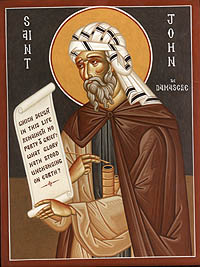
"Show me the icons that you venerate, that I may be able to understand your faith."

John of Damascus, Doctor of the Church

It is not enough to make the devotional life our main concern, and allow an occasional lecture or preachment on social matters to be added as a make-weight. The social life must be brought right into the heart of our devotion, and our devotion right into the heart of our social life. There is only one spiritual life, and that is the sacramental life -- sacramental in its fullest, its widest, and its deepest sense, which means the consecration of the whole man and all his human relationships to God. There must be free and open passage between the sanctuary and the street. We must destroy within ourselves our present feeling that we descend to a lower level when we leave the song of the angels and the archangels and begin to study economic conditions, questions of wages, hours and housing. It is hard, very hard, but it must be done. It must be done not only for the sake of the street, but for the sake of the sanctuary, too. If the Real Presence of Christ in the Sacrament obscures the Omnipresence of God in the world, then the Sacrament is idolatrous, and our worship is actual sin, for all sin at its roots is the denial of the Omnipresence of God. I have been to Mass in churches where I felt it was sinful, sinful because there was no passion for social righteousness behind it. When ye spread forth your hands I will hide mine eyes from you; yea, when ye make long prayers I will not hear you; your hands ate full of blood . . . Cease to do evil, learn to do well. Seek judgement. Relieve the oppressed. Judge the fatherless, plead for the widow. Little children, keep yourselves from idols.

Rev. G. A. Studdert-Kennedy, at the 1923 Anglo-Catholic Congress, London.

I recall you in the last place to the Christ of the Blessed Sacrament. I beg you, brethren, not to yield one inch to those who would for any reason or specious excuse deprive you of your Tabernacles. I beg you, do not yield, but remember when you struggle, or, as Father Frere told us today, when you fight for the Church -- do remember that the Church is the body of Christ, and you fight in the presence of Christ. Do not forget that. I want you to make your stand for the Tabernacle, not for your own sakes but for the sake of truth first, and in the second place for the sake of reunion hereafter. But for the truth, because the one great thing that England needs to learn is that Christ is found in and amid matter -- Spirit through matter -- God in flesh, God in the Sacrament. But I say to you, and I say it with all the earnestness that I have, that if you are prepared to fight for the right of adoring Jesus in his Blessed Sacrament, then you have got to come out from before your Tabernacle and walk, with Christ mystically present in you, out into the streets of this country, and find the same Jesus in the people of your cities and your villages. You cannot claim to worship Jesus in the Tabernacle, if you do not pity Jesus in the slums.

Now mark that -- this is the Gospel truth. If you are prepared to say that the Anglo-Catholic is at perfect liberty to rake in all the money he can get no matter what the wages are that are paid, no matter what the conditions are under which people work; if you say that the Anglo-Catholic has a right to hold his peace while his fellow citizens are living in hovels below the levels of the streets, this I say to you, that you do not yet know the Lord Jesus in his Sacrament. You have begun with the Christ of Bethlehem, you have gone on to know something of the Christ of Calvary -- but the Christ of the Sacrament, not yet. Oh brethren! if only you listen tonight your movement is going to sweep England. If you listen. I am not talking economics, I do not understand them. I am not talking politics, I do not understand them. I am talking the Gospel, and I say to you this: If you are Christians then your Jesus is one and the same: Jesus on the Throne of his glory, Jesus in the Blessed Sacrament, Jesus received into your hearts in Communion, Jesus with you mystically as you pray, and Jesus enthroned in the hearts and bodies of his brothers and sisters up and down this country. And it is folly -- it is madness -- to suppose that you can worship Jesus in the Sacraments and Jesus on the Throne of glory, when you are sweating him in the souls and bodies of his children. It cannot be done.

There then, as I conceive it, is your present duty; and I beg you, brethren, as you love the Lord Jesus, consider that it is at least possible that this is the new light that the Congress was to bring to us. You have got your Mass, you have got your Altar, you have begun to get your Tabernacle. Now go out into the highways and hedges where not even the Bishops will try to hinder you. Go out and look for Jesus in the ragged, in the naked, in the oppressed and sweated, in those who have lost hope, in those who are struggling to make good. Look for Jesus. And when you see him, gird yourselves with his towel and try to wash their feet.

Rt. Rev. Frank Weston, Bishop of Zanzibar, at the 1923 Anglo-Catholic Congress, London.
Technorati Tags: ,

Friday, March 24, 2006

Flannery O'Connor on the Eucharist


"Well, if it's just a symbol, all I can say is to hell with it."

Flannery O'Connor

Can I dedicate this to Alan's Catholicism WOW retreat?

Sunday, March 12, 2006

Ignatius of Antioch: Regarding the Eucharist

2 Lent

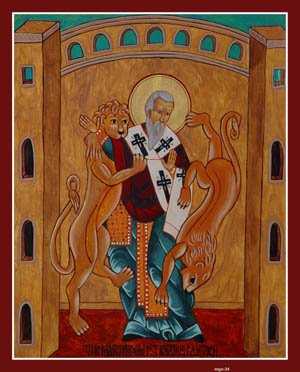
Ignatius of Antioch

I noted in the last post that Ignatius was concerned to combat the influence of docetism in the churches. In this letter to the Church at Smyrna, he draws what seems to him an obvious connection between right believing and right behavior (Ig. Smyr. 6.2):
"Now note well those who hold heretical opinions about the grace of Jesus Christ which came to us; note how contrary they are to the mind of God. They have no concern for love, none for the widow, none for the orphan, none for the oppressed, none for the prisoner or the one released, none for the hungry or thirsty."
The bishop does not offer an explicit rationale for connecting one to the other; indeed, this could appear to be an outright character assassination. I would rather suggest that this denunciation is grounded in the nature of the Docetic/Gnostic heresies: if material, physical existence is considered evil or unimportant, then Christian life and mission are essentially a matter of waiting out our present imprisonment in anticipation that God will free us from it. Therefore, there is no reason to build a positive, redemptive and redeemed common life here and now, and no impetus to alleviate the suffering of others. That would not be a Christian faith. Christian faith is a matter of believing in who Jesus is and what he has done and what he is doing and joining him in that. The Kingdom agenda is one of restoration and healing for the entire world that starts here and now in the Church.

The bottom line is that Jesus had a physical body, and this matters. It's how he saved us. We are his physical Body, who lead physical, redeemed lives in the present, and this leads to physical, redeemed lives in the future.

Ignatius continues speaking of his opponents:
"They abstain from the Eucharist and prayer, because they refuse to acknowledge that the Eucharist is the flesh of our Savior Jesus Christ, which suffered for our sins and which the Father by his goodness raised up."
Whaaaat? The Docetists refuse the Holy Communion because since Jesus had no actual flesh and blood, it cannot be a participation in his flesh and blood. The really interesting thing here is that as early as c. AD 110, the head pastor of one of the first Christian churches took for granted that bread and wine, broken and blessed, was indeed the body and blood of Jesus Christ.

Let's consider one more snippet of Ignatius' thought on the matter (Ig. Eph. 20.2):
"Continue to gather together, each and every one of you, collectively and individually by name, in grace, in one faith and one Jesus Christ, who physically was a descendant of David, who is Son of man and Son of god, in order that you may obey the bishop and the presbytery with an undisturbed mind, breaking one bread, which is the medicine of immortality, the antidote we take in order not to die but to live forever in Jesus Christ."
Leaving aside the matter of Ignatius' enthusiasm for the monarchical episcopate, I want to make some observations about what we do and don't see in these words regarding the Eucharist.

There is no reason to suppose that Ignatius had read enough Aristotle to have in mind a technical and complicated theology that approaches anything like a Roman Catholic doctrine of Transubstantiation. Indeed, any attempt to talk about the beliefs of early churches or the even the New Testament in terms of Reformation-era categories is to force people who lived more than fourteen centuries before the Enlightenment into the values and epistemology of that age. That's just poor history, to say nothing of lazy theologizing.

I find it provocative that so early in the life of the churches, one of its best-known bishops had a clearly mystical, clearly supernatural view of the cultic meal, and that Ignatius and other commentators who were so well versed in the apostolic writings would be so comfortable with it (See also Jared's essay, "Restoration, or Why I Look at the Exit Door," and To the Quiet: "Thoughts on the Eucharist").

I don't suggest that early writings are meant to be treated as canon, but that we must do business with them, as it were. Regarding the cultic practice of the Eucharist, I offer three affirmations and four denials:
  • I believe in the mystical presence of Christ in and at the Eucharist, and that in our eating, we consume the life of God, and take the new life of Jesus into ourselves in a greater fullness.

  • I believe that we make present again the ongoing salvation action of God in Christ at the atonement, and in so doing offer ourselves as sacrifices to God for the good of the world. The celebration of the holy mysteries shapes our live into a cruciform pattern.

  • I believe that this meal is an eschatological action, which makes more real and more present the ultimate salvation and judgment of our God.

  • I deny that faithfulness to and consistency with the Holy Scriptures ties me to an impoverished and minimalist theology of the sacraments. Indeed, I believe the opposite to be true: rich, sacramental theology grows out of the Scripture-reading and worship life of the Church.

  • I deny the Enlightenment, modernist denial of the supernatural and mystical that has been taken up by so many faithful and well-meaning Protestant Christians.

  • I deny the notion that any development in the life of the Church, regardless of how early or how broad, should be uncritically accepted and unconditionally obeyed.

  • I deny the notion that any development in the life of the Church beyond the letter of the New Testament must be a deviation or a plunge down a slippery slope toward the abuses of medieval Roman Catholicism.
There, I feel much better now. Have fun with that.

Wednesday, March 01, 2006

One in Christ, One in the Eucharist


The Didache

This early document, The Teaching of the Twelve Apostles, dates back to around AD 100. (See The Way of the Fathers: "The Time Capsule" for more background.) It begins with a discussion of the Two Ways, one of Life, and one of Death. There follows ethical, and then liturgical instruction.

From an early Eucharistic prayer:
As this broken bread was scattered over the hills and then, when gathered, became one mass, so may Thy Church be gathered from the ends of the earth into They Kingdom. (9.4)
And yes, you might take note that we have a record of prayers of consecration over the braead and wine (apparently in the context of a communal meal) as well as a post-communion prayer circa 100. I find it interesting that there's not a particular sacramental theology, but the prayers give thanks for Jesus and connect the bread and wine to the unity of the Church and God's provision in creation. There is further instruction on the sheltering of itinerant prophets, and warning against those who "trade in Christ" (12.5).

I've been doing some reading on the eschatological nature of the Eucharist: the rite itself is a sign and symbol of the new world that was inaugurated by the Risen Lord. For those who are part of the community, the Eucharist is a participation of redemption, and for those at odds, it is a sign of judgment. In the cross, we have been reconciled to God and to one another, and we offer ourselves on the altar. Therefore,
"On the Lord's own day, assemble in common to break bread and offer thanks; but first confess your sins, so that your sacrifice may be pure. However, no one quarreling with his brother may join your meeting until they are reconciled; your sacrifice must not be defiled. For here we have the saying of the Lord: 'In every place and time offer me a pure sacrifice; for I am a mighty King, says the Lord; and my name spreads terror among the nations'" (Didache 14).
Ben Finger is also blogging the Didache.
Find the reading plan here.

Technorati Tags: , ,

Tuesday, February 21, 2006

Apartheid, Eucharist, Sanctification (Again, not related.)

7 Epiphany
6 Hilary

Hey, check out the new graphic, courtesy of Alan: I have no Inquisition over which to preside, but I am God' s Jack Russell Terrier!

Some of you may be aware that the General Synod of the Church of England has taken some heat over its recent call for the divestment of stock in companies such as Caterpillar, that profit from the current apartheid policies of the Israeli state.

Personally, I think it's the right thing to do. Divestment, that is. Not apartheid.

From Canon Paul Oestreicher in yesterday's Guardian:
But the main objective of my writing today, is to nail the lie that to reject Zionism as it practised today is in effect to be anti-semitic, to be an inheritor of Hitler's racism. That argument, with the Holocaust in the background, is nothing other than moral blackmail. It is highly effective. It condemns many to silence who fear to be thought anti-semitic. They are often the very opposite. They are often people whose heart bleeds at Israel's betrayal of its true heritage.
If you want to discuss it here, read the whole of Oestreicher's piece first.

The over-systemization of our theologies really isn't good for us. Two of my friends have written posts that deal with some of the resulting difficulties, and how that hinders the unfolding of God's salvation in our lives.

Alan has some thoughts on that most sacred of practices, the Holy Eucharist.
...There has always been a faith that has been handed down from generation to generation, in the church catholic, that when the gifts of bread and wine were lifted up, that somehow God takes them and changes them and "this is My Body" becomes real again and that all this is connected to our faith and with the whole Body that is gathered - that somehow God's Holy Spirit is us transmits transformative power and we, also, are changed, healed, forgiven, drawn into further union with Him.
For some, however, "Reason has overtaken them and mystery is no longer acceptable."
- Alan Creech, "this is my body."

Mike Noakes raises some parallel objections to the way we understand salvation" and spiritual formation altogether, upon reading Dallas Willard's Divine Conspiracy:

What do you hear when "gettin' saved" is brought up?
Surely not an invitation to participate in Gods' Kingdom work right now as an apprentice of His Son, King Jesus, as being a reconciled, fully and truly alive human person actively working towards redeeming creation, the whole of the cosmos. Usually it's a little yellow card you feel out after you close your eyes and repeat the line of "God, I'm sorry." and go home (yes, I'm thinking of camp. I'm younger than most of you.) and do naughty things with your girlfriend. At least, that's what I've seen. You?
Ouch.

He argues that "sanctification ... has been held captive by theology systematic" is such away as to put it practically outside the experiene and possibility of real people. This grows to its most painful extreme when we find ourselves believing in our theological systems and trusting our own appropriation of "truth" rather than the living God:
We are told by the Holy Scriptures that Abraham believed God (not theology, not beliefs, but God) and it was credited to him as righteousness. He didn’t merely trust in some arrangement for an eternity at some ethereal party in the sky, he trusted in a very real, personal being who interacted with his life-happenings and was truly a person. He (Abraham) was NOT concerned whether or not he would go to this “heaven” after he passed on, he trusted God to be with him in this life and he worshipped only this being. And for doing so, he was declared a friend of God. And no friend of God will be in “hell.”
He's a bit verbose (pot, meet kettle), but it's worth thinking about, if you've not. Go read the whole thing: "Sin Management: God's Answer?"

And meanwhile, here's a reality check. A band of Muslims attempted to assassinate the Anglican Archbishop of Jos Diocese, Bishop Benjamin Kwashi. Please pray for his family, and all the Christians in the country. Details here, at TitusOneNine.

Christ have mercy.

Update: a letter from Bishop Kwashi, again at TitusOneNine.

Monday, January 30, 2006

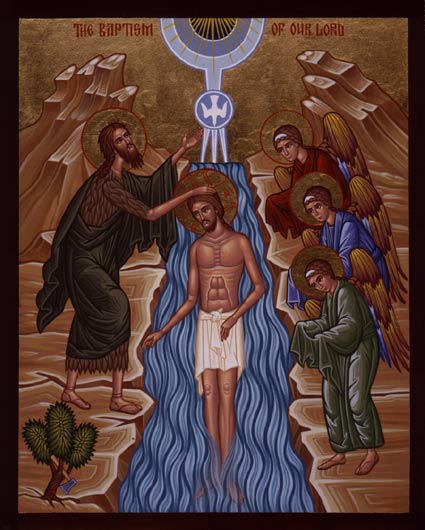
On Baptism

4 Epiphany
3 Hilary

Hey everybody!

I'm sorry to take so long in responding to your kind comments; my internet connection has been very spotty over the weekend.

As a result, I studied my Greek for two hours last night instead of blogging. Hoorah!

Okay, I'm reading the comments from the weekend, and I'm counting 19 Christians and 30 baptisms. That's a much lower number of baptisms than I expected to see. I'm going to offer a few reflections.

Christians of the Catholic tradition understand baptism to be a sacrament: when the church baptizes someone, something is Really Happening, that really matters regardless of one's subjective beliefs or feelings about it. One does not get to decide one's own baptism is invalid; well, one can, but that's not a binding judgment call in God's eyes. Baptising someone a second time? There's just no reason for it, so long as it was done with water by another baptized person using a Trinitarian formula.

Except for the practice of infant baptism, I'm comfortable with these things. I guess I believe in sacramental baptism for believers, and don't ask me what that's consistant with.

Now, Baptists believe that baptism is not a sacramental act, but rather an expression of dedication to Jesus and following his way of life. Infant baptisms are ignored. This makes sense to me. The problem with calling that first baptism "invalid," is that implies it to be a sacrament, an action that really mystically does something.

This is the problem with offering people "believer's baptism" over and over again, which is a fairly common practice in Baptist churches, at least in Kentucky. If baptism doesn't do anything, why does it matter if it was done "right" or not? If someone has already made a public profession of faith as what the church considered to be a believer (even at 5 years old, which is problematic both theologically and pastorally), why do it again?

It is not by any means scriptural for someone to be "saved" over and over again.

I have known so many people in these churches who make their faith commitment, and do it over and over again, because they're afraid of going to hell anyway. I don't know what teenagers are taught to read, or who preaches to them that they need to worry about "their salvation" constantly. So people "re-commit" and are re-baptized in the hope that it "takes." That's just horrible.
...if anyone causes one of these little ones who believe in me to sin, it would be better for him to have a large millstone hung around his neck and to be drowned in the depths of the sea.
And what about the ones who wound the tender consciences of the little ones, and cause them to believe they're in a state of sin all the time, so that they learn the sheer terror of Jesus, whom they can never trust to really save them, and learn to be fearful of hell?

I welcome responses and reflections to any of the above. Or, perhaps we can chat about these questions:

Imagine you're a pastoral leader in a Christian church, responsible in some way for the guidance of souls and the policies of the congregation. How would you respond to these situations, and why would you do it that way?
  1. An adult says to you, "I was baptized as an infant, and now I want to do it for real."
  2. Another says, "I was baptized in this church when I was 8 because I made a profession of faith. I don't think it was real, but now I think I'm really saved. Should I be baptized again, so it's scriptural?"
  3. Another: "My daughter is 5, and she says she believes in Jesus and wants to accept him as her Savior and Lord. Can she be baptized?"
Alright, so here's what I would do.
1. "Hey, your baptism was real. God's people did something on God's behalf, that joined you with Christ. Now you need to own that committment, and talk about how you can spend a lifetime following through with it. Let's work on making vows to Jesus - renewing your baptismal vows.

2. "You made your profession, and recieved baptism. We can talk about renewing your vows, but you need to understand that it's normal to know Jesus better and know Jesus different as you get older, and for your committment to increase and to change. The reality of that change does not invalidate your previous belief, in the same way that knowing and loving your friends better does not mean you didn't love and know them before."

I would also stop the congregational practice of baptizing people under the age of 16.

3. "No."
Anybody want to play with this for a bit? I'll reflect on "Adoration of the Blessed Sacrament" a little later on.


Friday, January 27, 2006

Interactive Poll

3 Epiphany
2 Hilary

Hey, everybody. I've had a nice week, but I think I might talk about that on my upcoming Sunday podcast.

I might tell a story about churches. I've not decided yet. In the meantime, I have a couple of unrelated questions, open to any readers.

1. If you're a believer, have you been baptized? What Christian tradition are you part of, and how many times have you been baptized? I have a crackpot theory that the lower the view protestants have of baptism, the more they like to practice it.

2. Do you have an experience with a kind of prayer (from the Roman Catholic tradition) called "Adoration of the Blessed Sacrament"? (For my protestant readers, I'll just say that it's pretty much what it sounds like.) Would you like to share any thoughts or experiences?

Sunday, September 18, 2005

Sacramental Theology

If you're just joining us, I'm recounting the reasons I found Anglicanism attractive.

Why Anglicanism? Part I

Regarding the Lord's Supper, Baptism, Confession, and What it Means to be Saved

I believe that Jesus is present to us in our celebration of Holy Communion. I believe that as he said when he instituted the meal, "This is my body, this is my blood." Cannibalistic? Yes. Mystical? Without a doubt. I don't believe that the reception of this meal could do any other than bring transforming power into the lives of those who recieve it.

If you wish to call it "symbol," I'll warn you very frankly: nothing is a “mere symbol.” Nothing is more powerful, nothing more real than symbol. A symbol is a physical sign of an abstraction, but both the physicality and the idea itself are very real.

When he celebrated the Passover, that great meal of God’s liberation, Jesus blessed it, saying “this is my body, this is my blood.” If nothing else, on a gut level, I believe him to be present in our celebration in a way that cannot be quantified or explained. I enter into union with him, and he with me – like a renewal of covenant, we both make our promises to each other again.

(see also On the Eucharistic Life)

In the same way, I was bothered by the Pauline phrase, “baptized into Christ.” I never cared for the Campbellite version of “baptismal regeneration,” (which is what most in these parts are familiar with) but I’m not really interested in Enlightenment-era salvation, either. Salvation is not my activity. It is God's. So is baptism something God does? Is it an action of the Church? Is it my own action? I am of the persuasion that baptism is something the Church does for God, acting out his redemption and making a tangible offering of grace to the convert.

Christians enter into God’s salvation of the world. It is not a shiny trinket that we possess so long as we believe the right things about Jesus in the right way. Further, I believe that something meaningful and real happens when I confess my sins to a brother and he exercises his priesthood by pronouncing God's absolution. In private confession, not only am I known and loved as a sinner, but also restored to God in the most concrete fashion. Dietrich Bonhoffer’s short work, Life Together, (as well as deep, caring friendships in the Body of Christ!) helped me with this idea.
Our brother breaks the cycle of self-deception. A man who confesses his sins in the presence of a brother knows that he is no longer alone with himself; he experiences the presence of God in the reality of the other person. As long as I am by myself in the confession of my sins everything remains in the dark, but in the presence of a brother the sin has to be brought into the light (116).
And I’m referring, mind you, to the priesthood of the baptized. This would make me very naughty in many Anglican circles. Like, outside of the Diocese of Sydney. Shh, don't tell anyone.