Sunday, November 14, 2004

Bozo: "The World's Only Mind Reading Dog"


And pretty much still the world's only mind-reading dog Posted by Hello

I found this being used as a bookmark in a 1933 bank ledger in the College Archives. See, I do neat things all day. More details on Bozo here.

Monday, November 08, 2004

Windsor Commentary II: Conservatives, Liberals and Gay Theology

As I read and listen to reactions to the Windsor Report given by the various voices on the 'Net (and a few I get to overhear) I am struck by a particular theme: the inability (refusal) to recognize that that not only do people on various sides of these issues have different perspectives, but entirely different worldviews.

Many on the left take for granted that a theology that will pronounce homoerotic relationships as part of God’s creative and redemptive intention for his image-bearers is ultimately an issue of gay liberation. The oppressed are finally being listened to, and that will change things. Let me clarify here that violence against others is always wrong, and that homophobia is wicked and evil. The problem is that the oppressed are being granted epistemological priority: their narrative is now to be super-imposed over everyone else’s, and it will be the overarching story into which every other story fits.

Beware the tyranny of the oppressed: forcing everyone to conform to the (felt, experiential) truth of the oppressed is not a reasonable corrective to the former practice of everyone conforming to the (felt, experiential) truth of the oppressors. What’s more, not everyone buys into the narrative of oppressor/oppressed. While you find elements of liberation in the Christian story, it must be said that classical recapitulation / Christus Victor (freeing the Creation from the principalities and powers and placing it under the headship of Christ) is not the same as post-modern liberation: God-empowered self-actualization over and against those who would keep you down.

I hear often that the decisions at ECUSA’s 2003 General Convention (encouraging the blessing of same-sex unions and confirming the election of Rev. Canon V. Gene Robinson to the see of New Hampshire) represent a step forward with the Holy Spirit, and that the Africans (and American conservatives) are asking “us” to step back. Not all steps are forward or backward. I think it’s a step down from the kind of life Christians are intended to live together.

It’s not about scriptural interpretation. It’s about worldview, and whether one considers New Testament sexual ethics to be normative and binding for the Christian Church. I don’t think anyone’s questioning what the NT norms are themselves.

Check out Oliver O’Donovan’s thoughts on the left/right extremes as well as the state of “gay theology” (and see here for the entirety of his essay on the Windsor report):
Nobody reading Resolution 1.10 of Lambeth 1998 – and I am among those who read it sympathetically and appreciatively – could seriously pretend that it was supposed to represent the last word about homosexuality or about the church’s pastoral practice in relation to its homosexual members. It simply set responsible bounds within which we could approve one another’s pastoral practice in good conscience to Scripture and tradition while continuing to explore together a phenomenon of extreme cultural and anthropological complexity. The difficulty the church faces with such an exploration is that left and right wings, in almost equal measure, seem to think that there is nothing to explore. Either Scripture and Tradition have Settled it Once and for All (though how well our phenomena match those that Scripture and tradition addressed is an open question until we have learned to describe our phenomena better); or else Science has Taught us Better, (though no one can quite remember what the scientific experiments were, or what they were supposed to have demonstrated). Our greatest difficulty is that we all follow faithfully the ironic advice of Hilaire Belloc: O let us never, never doubt What nobody is sure about!

If anyone thinks that a prolonged exploration would simply hand a victory to revisionists, let me recall that in 1997 a group of British theologians (“traditionalists” as the press would call them) put some questions, chiefly about theological anthropology, to advocates of the gay cause in the churches – hoping for a reply that would bring to clear expression gay thinking about the gay position and so provide something to discuss. I was among the authors of the so-called “St. Andrew’s Day Statement” – and to the best of my knowledge the questions I and my colleagues then asked have not received the first shred of an answer. The Christian gay movement is not, by and large, a self-theorising movement. For that reason the distinctive experience it wants to attest is often inarticulately expressed, and easily swamped by a well-meaning liberal social agenda of championing all minorities in sight, an agenda which is precisely uninterested in what makes the gay experience different. All this poses a problem for the church, since it means that any possibly helpful pastoral initiative risks signing up, unwittingly perhaps, to a dogmatic revolution. In a world where nothing is clearly explained, all cheques are blank.

(The above emphasis is mine) I’ve read some theology done by the Christian gay movement, and must point out (I don’t think many people know this) that there isn’t a consensus of those thinkers that civil unions, marriages, or “long-term relationships marked by full fidelity” is what homosexual men and women ought to be striving for in church and society. Such arrangements are considered by some to be a product of heterosexist norms and to strive for those is still a way of conforming to the desires of the “oppressor.”

All cheques are indeed blank: can any of these well-heeled, educated, guilty white liberals draw boundaries on what “liberation” ought to mean?

Wednesday, November 03, 2004

It’s Overcast Today: Elections and the Will of God

The actions and policies of President Bush are not “closer” to the will of God than those of John Kerry. Neither would the opposite be true. Neither of these men is concerned with embodying the reign of God in their decisions, and this is evidenced by the words and actions of both men. Whether or not, then, the reign of Bush or Kerry would be “more Christian,” is a dead question. Neither would be Christian, because only the Reign of YHWH is “Christian.” There is, however, room to discuss whether or not particular policies or actions follow charity and justice. But the role of government can never be seen as a building block or capstone for the mission of the Church.

Remember that the reign of George W. Bush is not the Reign of God. Nor would the Kerry administration have been. As soon as we start using language that allies the reign of any Caesar to that of YHWH, we are guilty of idolatry.

George W. Bush is not “God’s man,” no matter what election he wins. God’s man was and is Jesus of Nazareth, the Messiah, who came to put to rights everything that went wrong in the Fall of Creation. He, and by extension the Christian Church, are God’s preferred, primary, and quite possibly only means for the redemption of the world. Bush will not put things to rights, and neither would Kerry.

Saturday, October 30, 2004

Single People are Pathetic

Got your attention?

I have a few disconnected rants against the language of "singularity" and "singles ministry," at least as I understand it:

Whenever I've been present for singles meetings, either in Texas or Kentucky, things got around to "recognition of singles" by "the church." I don't understand what the deal is with the generation before mine wanting some ethereal entity called "the church" to bless their way of living. Is complaining about this entity some kind of parental displacement? I don't concern myself whether "the church" or "lots of people" think that not being married at age 14, 22, 30, or never, is weird. What think the people who love me? What kind of man or woman, and in what way, am I called to be?

I am not married, and I won't be soon. I am attempting to cultivate a holy celibacy, belonging to God and to my community, a local grouping of the Body of Christ. I do not need some prancing prelate priestling pontificating from a pulpit to inform me that this is an acceptable way of life. I would be insulted by the attempt. My friends and I do quite well discerning my vocation. Christianity, Inc. and assorted associates can keep their opinions to themselves.

I am not single, or alone. Lots of people, including Christians, would say that I'm single, and not in a relationship. How sad it would be if that were true! What's with this "in a relationship" language? No wonder so many unmarried people feel worthless and unloved: they choose language that gives explicit value only those relationships that in some way sexual (or at least romantic) and implicit devaluation to those that are not. "No, I'm not in a relationship." Of any kind? With anyone?

If that's the way I saw it, I would certainly feel pathetic. But I am in lots of relationships, with lots of people. They love me, and I love them, and that's important. We learn to love well. We are committed to one other through our baptism and unity in the truth, empowered to love and remain by the Holy Spirit. Sexual relations would obviously not improve those friendships (for many, many reasons), but that's what's implied by the language of "in a relationship" and "just friends." Non-sexual relationships are second-best. Everyone knows that, apparently.

Christians are picking up the world's false views on healthy intimacy and happiness, and once again failing to teach a redemptive and healthy sexuality as a consequence. I think these false views of what it means to be with others and to be alone foundational to the idea of a "singles ministry," and why I don't share the enthusiasm of some of my colleagues.

While I am not in a romantic or sexual relationship with anyone, I am not "single" in any way that is meaningful to me, and I am certainly not "alone." For that reason, I could not in good conscience do "singles" ministry. I've not met any peers at this point in my life who see the need for such a thing, because for most of us it would unnecessarily separate us from our friends in the life of the Church.

At its worst, I think it becomes a lonely persons ministry or a matchmaker gathering, meant to offer "another chance" at dating or assuage the woundedness of those who experience continual relational disintegration. It can't ultimately heal those conditions because the premise is faulty: that unmarried (celibate) people are a different class of human, and need to be treated as such. In attempting to overcome the felt alienation of singles, these ministries increase it by buying into the assumptions of the cultural and ecclesial assumptions they hope to challenge.

And that's what I think about that.

Technorati Tags: , ,

Monday, October 25, 2004

An Emo Installment: And I Don't Think I'll Miss Her at All

Fall Break has come and gone, but I think I made the most of it. I visited the folks at Vineyard Central this weekend; I feel pretty encouraged in terms of my discernment. There are indeed folks in the last couple of generations who are actively discerning what faithfulness to the Gospel means in terms of their ecclesiology and common life. It’s probably arrogant of me, but I was starting to think it was just me and a handful of friends. The gathering at La Roca a few weeks ago was good for that, as well.

Reading the first thirty pages of the Windsor Report as well as Mission Shaped Church from the Church of England has reminded me that mission and a catholic, missional, sacramental ecclesiology just might be in the Anglican DNA. This in spite of what I’m experiencing with rank and file Episcopalians. Maybe they’re mutants?

I showed my face at "church" for the last time yesterday. I had been growing tired of trying to make friends in a group of people with whom I couldn’t sustain a conversation of more than two minutes. I didn’t care about receiving the Eucharist or the music, (consuming or producing religious goods and services), but was only there to make friends with people. Three months of laborious coffee drinking later, and I still have to nearly pounce on people to have a quick, superficial conversation. Of course, it might just be my age, or values, or personality. I wear some pretty bright shirts, for example, and Jeremy (my roommate, the house god of snappy banter and fun times) says that they can be intimidating.

To say nothing of what I saw in vestry meetings. I’ve alluded to that before, so I’ll leave it be.

If a church ever tells you they’re a friendly bunch, know that they’re lying. Ask somebody who’s visited their house, instead.

I’m trying to drop angry language though. The whole thing just hurts, y’know?

I feel like I’ve broken up with a girl, from an odd kind of relationship in which the idea of romance was nice, but neither one of us was really into it. Or more like it, I just had a crush that was in no way reciprocated. Why keep crushing? What did I want to get out of it? I mean, anybody could have said she wasn’t my type.

What was the point of that little experiment? I don’t know. I’ll think about it and get back to you.

Friday, October 22, 2004

Opinion on the Windsor Report

For my part, I'm on page thirty-something of the sucker. So far it looks to me like it's staying that there are various reasons that ECUSA should not have "consecrated" Canon Robinson, the Canadian Diocese of New Westminster should not have approved a liturgy for the blessing of same-sex unions (to say nothing of declaring them to have official "sanctity") and that ECUSA bishops should stop performing marriages/blessings of same-sex couples. (Which, by the way, at least the bishop of Vermont has refused to do, and the bishop of D.C. has refused to stop his priests)

Gene Robinson says that he's glad to report doesn't say he shouldn't have been consecrated. I'm thinking he's not read it, as paragraphs 33 and following say that "present problems have reached the pitch they have" because ECUSA practiced theological innovation

1. without doing proper foundational theological work (33)

2. without following existing procedures for consulting with other Anglicans in that work (35)

3. ECUSA and the Diocese of New Westminster "hold to the opinion, at least by implication, that the questions they were deciding were things upon which Christians might have legitimate difference, while large numbers of other Anglicans around the world did not regard them in this way" (37). And you know, it's not like they weren't told this by many voices long before they did it.

4. The above parties "assumed...that they were free to take decision on matters which many in the rest of the Communion believe can and should be decided only at the Communion-wide level" (39).

Catholicity is a major issue (we'll leave aside the authority of scripture, just for the moment). If you want to make an formal innovation to Christian theology, you must consult. You don't get to just decide as if the Church of Jesus Christ were a local franchise that you get to run as you please. The bigger a question (or challenge) is, the wider one must consult. In regard to this de facto alteration of the Church's teaching on sexuality, the wider Communion (and the Church universal) has spoken against it. No, says Griswold, we're just a local franchise, and it only affects us.

I'm still reading. I'll get back to you on the rest...

Wednesday, October 13, 2004

Eugene Peterson: Spirituality and Commitment

Shun spirituality that does not require commitment. Personal commitment to the God personally revealed in Jesus is at the heart of spirituality. Faddish spiritualities, within and without the church, ignore or deny commitment. Evangelical counsel places the Lord's commands - believe, follow, endure - at the core of all spirituality. A lifelong faith commitment to God as revealed in Jesus Christ is essential to any true spirituality.

"Ecstasy doesn't last," wrote novelist E.M. Forster, "but it cuts a channel for something lasting." Single-minded, persevering faithfulness confirms the authenticity of our spirituality. The ancestors we look to for encouragement in this business - Augustine of Hippo and Julian of Norwich, John Calvin and Amy Carmichael, John Bunyan and Teresa of Avila - didn't fit. They stayed.

Spirituality without commitment is analogous to sexuality without commitment - quick and casual, superficial and impersonal, selfish and loveless - eventually a parody of its initial promise. Deprived of commitment, sexuality degenerates into addiction, violence, or boredom. Deprived of commitment, spirituality, no matter how wise or promising, has a short shelf life.

– Eugene B. Peterson, Subversive Spirituality

Sunday, October 10, 2004

Athanasius: We are being raised

When the sun rises after the night and the whole world is lit up by it, nobody doubts that it is the sun which has thus shed its light everywhere and driven away the dark. Equally clear is it, since this utter scorning and trampling down of death has ensued upon the Savior’s manifestation in the body and His death on the cross, that it is he Himself who brought death to nought and daily raises monuments to his victory in his own disciples.

– Athanasius of Alexandria, 296-373, On the Incarnation, 29.

Thursday, October 07, 2004

McGrath: Experience and Theology

Experience cannot be allowed to have the final word – it must be judged and shown up as deceptive and misleading. The theology of the Cross draws our attention to the sheer unreliability of experience as a guide to the presence and activity of God. God is active and present in his world, quite independently of whether we experience him as being so. Experience declared that God was absent from Calvary, only to have its verdict humiliatingly overturned on the third day.

– Alister McGrath, The Mystery of the Cross (Zondervan, 1990)

Monday, October 04, 2004

Mark Greene on the Sacred/Secular Divide

Mark Greene argues that “we set a lower educational standard for the way we teach kids in our churches than the standard set in the school room.”

I’ve been thinking about this for awhile: my experiences in most local churches thus far has made it clear that high schools expect a higher level of thought work from teenagers than churches do of adults at any point in their lives.

He blames “the sacred-secular divide: the pervasive belief that some parts of our life are not really important to God – work, school, leisure – but anything to do with prayer, church services, church-based activities is.”

He continues:
In sum, we teach our kids very young that what they do between 9 to 5, Monday to Friday, is not important to God. And we also teach them that their minds don’t really matter to God either. So it was that the national leader of an evangelistic ministry said, “We teach gentle Jesus, meek and mild to teenagers in church. Meanwhile in the world they’re studying nuclear physics.” That’s SSD – setting a lower standard of educational expectation for church teaching than for school, treating adolescents like kids, communicating to them that thinking matters in the world but not in the church [emphasis mine – KP]. That’s SSD, treating church time as if it we are primarily in an entertainment environment, rather than in a vigorous, worshipful, learning environment.

From the London Institute for Contemporary Christianity

Thursday, September 30, 2004

Tom Ehrich: Life Wasn’t Better in the ‘50s

Have you ever listened to somebody long for purer, simpler times? You know, when Western Civilization wasn’t crumbling around us? I took a history degree, and it’s my considered opinion that it’s always been crumbling. Pick out bits of literature from any given generation, and you’ll find laments about how the younger generation was going to destroy them all.

It’s not a new phenomenon. And it’s similarly silly when people go on about how the values of consumerism, materialism, et al. that have been spontaneously generated by my peers is going to destroy us all. No generation spontaneously generates its own values. We receive them and build upon them.

Here’s a bit from Tom Ehrich, though I do recommend that you read the whole piece.

Having experienced the 1950s, both as idyll and as truer stories encountered later, it perplexes me when that decade is held up as a golden era, a model of what modernity ought to be, as though everything would be right in the world if we reclaimed neighborhood schools, restored women to the kitchen and male dominance in the workplace, if churches "got back to basics," if diversity and immigration could be discouraged. And everything were made simple again.

It wasn't simple then.

It only seemed simple because we were children. In fact, the 1950s were as odd in their own right as subsequent decades, the only difference being that post-war Baby Boomers experienced the 1950s as children, the 1960s and 1970s as adolescents, and the years since then as adults vulnerable to uncertainty.

Besides, not all Americans in the 1950s were safe and serene, as gossamer stereotypes insist. Many experienced the '50s through Jim Crow laws, broken marriages, unacknowledged incest and alcoholism, an artificially induced arms race and pillaging by the wealthy, which would bear horrific fruit in later decades.

The retro yearnings of our day claim to be a search for better ethics, better religion and better citizenship. In fact, they are a search for lost childhood.

We were young, naive and safe. We lost that seemingly golden era, not because communists, secular humanists, moral relativists, situational ethicists, Presbyterians, hippies or liberals stole it from us, but because we grew up. And no amount of anti-modernist yearning will put Humpty together again.
From the Texas Baptist Standard

Wednesday, September 22, 2004

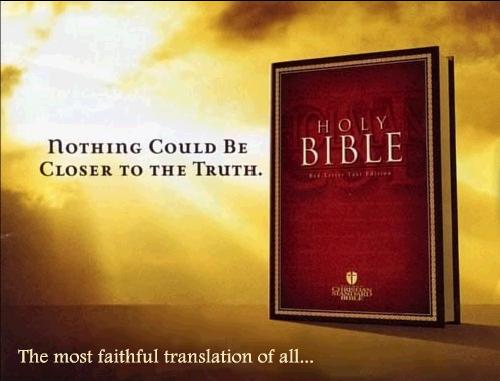
Nothing Could Be Closer to the Truth


The Holman CSB Posted by Hello

Please notice my new slogan. Please note that it's not a proclamation of my exegetical infallibility (I'll let you conclude that on your own) but rather a parody of something almost as ridiculous.

Check this out: The Holman Christian Standard Bible. All of the translators came to the Greek and Hebrew texts with a pre-existing doctrine of the Scriptures called "Inerrancy." Aside from being a silly idea, it is a recent invention, and in my not-so-humble opinion, a product of Enlightenment thought. I will craft a polemic on this some other time.

But because of this doctine, the Holman CSB carries this slogan: "Nothing Could Be Closer to the Truth." Instead of trying to avoid particular sectarian biases, the publishing arm of the Southern Baptist Convention as made it an attractive marketing point.

The SBC has joined the ranks of the Latter-Day Saints, the Jehovah's Witnesses, and the Roman Catholic Church in producing their own denominational bible translations.

And the Holman CSB is wholeheartedly endorsed by Pat Robertson.

So with that said, I present to you, "Captain Sacrament: Nothing Could be Closer to the Truth."

Monday, September 20, 2004

+1 Mace of Tertullian

God bless those early writers and their blunt instuments:

We hold communion with the apostolic churches because our doctrine is in no respect different from theirs. This is our witness of the truth.

Tertullian, c.197, 3.252-3


It is unlawful to assert that the apostles preached before they possessed "perfect knowledge," as some do even venture to say, boasting themselves as being improvers of the apostles. For after our Lord rose from the dad, the apostles were energized with power from on High when the Holy Spriit came down [upon them]. They were completely filled and had perfect knowledge. They departed to the ends of the earth, preaching the glad tidings of the good things sent to us from God.

Irenaeus, c.180, 1.414.

Saturday, September 11, 2004

The Word "Love" Is Inadequate

At some point in recent Episcopal history, the innovators, who were now much more interested in new morality than new theology, starting dropping all their
prophetic, ground-breaking, barrier-breaking, new world exploring rhetoric -- the rhetorical mode that had sustained skeptical Christianity for the 20th century, most used, or most loudly declaimed, in the 1960s and early 70s -- and started talking about themselves as if they were perfectly orthodox believers. I suspect the same happened in other mainline denominations.

This, they obviously thought, would provide some excuse for doing what almost everyone recognized as ground-breaking and barrier-breaking, if not (opinion was divided on this) prophetic and new world exploring. Some felt that the barriers being broken were like corsets oppressing women yearning to breath free, others that the barriers were like guardrails keeping reckless, foolish, inattentive, or suicidal people from driving their cars into the Grand Canyon.

The liberals' problem was convincing everyone else that what had once been universally held to be wrong was now as mainstream as American cheese in suburban Sioux Falls, Iowa, and as bland and inoffensive as beige carpets. Hence the appeal, which the Rev'd Ms. Russell adopts, to a high but abstract principle derived from a Dominical teaching taken out of context.

Thus the moral innovators could claim to be "biblical," because the principle to which they claimed allegiance was indeed found in the Bible, without having to trouble themselves to find, or to obey, what the Bible actually said. Making the word "love" the sole authoritative principle without further definition destroys all possibility of reason, and therefore of challenge.

The word by itself suggests wisdom, insight, sensitivity, even godliness, but by itself means nothing practical, nothing specific. It is a bag into which one can put anything one wishes and get it through customs, a get-out-of-jail-free card any criminal can use, a magic wand that makes all problems disappear. [emphasis mine -kp]

Except that what Ms. Russell calls absolutism, fundamentalism, and puritanism simply articulates what the Bible tells us about reality. More to the point, it articulates what God has graciously told us about reality because on many matters, like the nature and exercise of sexuality, we don’t want to see what we should see, what is indeed right in front of us. We need the details, not just general instructions to “love.”

From David Mills, in Touchstone Magazine - Mere Comments

Thursday, September 09, 2004

The Problem with Sola Scriptura

The translation and interpretation of Holy Scripture is the task of the Church brought into being by the same Holy Spirit who inspired the written Word. The protesters who broke with Rome cannot have foreseen the fissiparous nature of their enterprise. In rejecting the authority of the Pope the Western reformers did not abolish autocracy but rather set in train a process the logical end of which is that every man is a pope in his own parish or in his own front room. The ‘idolatry’ of Rome was replaced by the idolatry of self, social group and nation in swift order. Reformation hopes gave way to puritanism. Parts of Europe descended into the fierce joylessness of Calvinism, others to the excitements of Anabaptism, revivalists, iconoclasts, Pentecostalists etc, each seizing upon an aspect of the faith and overemphasizing it to the distortion of the whole. The upshot is hundreds of ‘churches’, most of them with their own bizarre subdivisions (low, strict and particular, Southern, open etc, etc). In addition, there are thousands upon thousands of one-man band conventicles brought about by the falling out of Brother Smith with Pastor Jones. Pastor Smith, as he has now appointed himself, has the ‘real’ truth and hopes shortly to be needing to rent a bigger Scout Hut than the gravely misled Pastor Jones, his former guru. While both (and millions like them) claim, sola scriptura, the authority of the Word, they are in fact claiming merely a personal authority to interpret God’s Word with no reference to the historic and living community of faith. It is little better than theological piracy and insupportable vanity. It is the rejection, all too often, of the teaching of the Church in favour of the cult of private opinion. In an age which has so comprehensively rejected traditional forms of authority and embraced the highest good as individual gratification, it is scarcely surprising that disintegration is gathering pace.

From Robbie Low, "Divided We Fall," in New Directions, August 2004, pp. 17-18.