Tuesday, March 14, 2006

Reading the Bible, VI: Systemization

2 Lent
One of the characteristics of the Bible is precisely the absence of a sense of systematization and the presence, on the contrary, of things held in dynamic tension. The Bible is a repository of many ways of interpreting the same events and reflecting upon the same problems. In itself it urges us to avoid excessive simplification and narrowness of spirit.

- The Interpretation of the Bible in the Church, Pontifical Biblical Commission, 1994
This is why an overemphasis on "doctrine" and "systematic theology" freaks me out. If you need a chart to explain your theology, it's probably wrong. When we start going around and systematizing what the Bible is not interested in systematizing, we run a serious risk of replacing the authority of the Scripture with our own systems.

That's what we call an idol, boys and girls.

It seems to me that the Bible is interested in telling the story of God and his people. Telling and retelling it. Sometimes different emphases are put in different places. There were editors. I don't think it hurts anything to affirm that. Am I wrong?

Technorati Tags: ,

Doing Theology: Finding Answers

2 Lent

Speaking of "Truth," N.T. Wright's article, "My Pilgrimage in Theology" is worth a read, particularly these first paragraphs:
Most theological students associate John Wenham with Greek grammar. Not me. I was in an undergraduate audience which he addressed in 1970. He urged Bible-loving Christians to consider theological study and a ministry of teaching and writing. His model was that of the stream from which Christians drink. The stream is polluted by bad theology. Our task is to feed in good theology. ‘Trickle-down’ theories are risky, but I think this one works. I had been heading for parish ministry; from that day on I knew God was calling me to an academic, though still very much church-related, vocation.

As so often, I attacked this vocation the wrong way. When I began theology, I assumed that all writers not published by the . . . Press, or perhaps the . . . of . . . Trust, were suspect. If I read the right books I would find the ‘answers’. Fortunately, after two years of soaking myself in the Bible itself, I was so gripped with the excitement of exegesis, and the new horizons it opened up that I didn’t worry so much about ‘sound’ answers. I continue to respect the Reformers, and men like Charles Simeon, of 200 years ago, John Stott, Jim Packer and Michael Green, at whose feet I was privileged to sit, and whose work in a variety of ways created space for me to do things differently. Where I disagree with them it is because I have done what they told me to: to read Scripture and emerge with a more biblical theology. The evangelical tradition at its best encourages critique from within. It sends us back to the Scripture which stands over against all traditions, our own included.
While we're on the topic of Bishop Tom's writings, check out this other article, "Farewell to the Rapture." HT: (TitusOneNine)
The American obsession with the second coming of Jesus — especially with distorted interpretations of it — continues unabated. Seen from my side of the Atlantic, the phenomenal success of the Left Behind books appears puzzling, even bizarre. Few in the U.K. hold the belief on which the popular series of novels is based: that there will be a literal “rapture” in which believers will be snatched up to heaven, leaving empty cars crashing on freeways and kids coming home from school only to find that their parents have been taken to be with Jesus while they have been “left behind.” This pseudo-theological version of Home Alone has reportedly frightened many children into some kind of (distorted) faith.
...
The Ascension of Jesus and the Second Coming are nevertheless vital Christian doctrines, and I don’t deny that I believe some future event will result in the personal presence of Jesus within God’s new creation. This is taught throughout the New Testament outside the Gospels. But this event won’t in any way resemble the Left Behind account.
On that note, I'd like to reaffirm that just because somebody doesn't believe some aspect of the Christian faith in the same way you do, doesn't mean s/he doesn't believe it at all.

Sunday, March 12, 2006

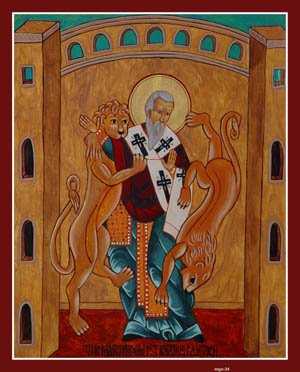
Ignatius of Antioch: Regarding the Eucharist

2 Lent

Ignatius of Antioch

I noted in the last post that Ignatius was concerned to combat the influence of docetism in the churches. In this letter to the Church at Smyrna, he draws what seems to him an obvious connection between right believing and right behavior (Ig. Smyr. 6.2):
"Now note well those who hold heretical opinions about the grace of Jesus Christ which came to us; note how contrary they are to the mind of God. They have no concern for love, none for the widow, none for the orphan, none for the oppressed, none for the prisoner or the one released, none for the hungry or thirsty."
The bishop does not offer an explicit rationale for connecting one to the other; indeed, this could appear to be an outright character assassination. I would rather suggest that this denunciation is grounded in the nature of the Docetic/Gnostic heresies: if material, physical existence is considered evil or unimportant, then Christian life and mission are essentially a matter of waiting out our present imprisonment in anticipation that God will free us from it. Therefore, there is no reason to build a positive, redemptive and redeemed common life here and now, and no impetus to alleviate the suffering of others. That would not be a Christian faith. Christian faith is a matter of believing in who Jesus is and what he has done and what he is doing and joining him in that. The Kingdom agenda is one of restoration and healing for the entire world that starts here and now in the Church.

The bottom line is that Jesus had a physical body, and this matters. It's how he saved us. We are his physical Body, who lead physical, redeemed lives in the present, and this leads to physical, redeemed lives in the future.

Ignatius continues speaking of his opponents:
"They abstain from the Eucharist and prayer, because they refuse to acknowledge that the Eucharist is the flesh of our Savior Jesus Christ, which suffered for our sins and which the Father by his goodness raised up."
Whaaaat? The Docetists refuse the Holy Communion because since Jesus had no actual flesh and blood, it cannot be a participation in his flesh and blood. The really interesting thing here is that as early as c. AD 110, the head pastor of one of the first Christian churches took for granted that bread and wine, broken and blessed, was indeed the body and blood of Jesus Christ.

Let's consider one more snippet of Ignatius' thought on the matter (Ig. Eph. 20.2):
"Continue to gather together, each and every one of you, collectively and individually by name, in grace, in one faith and one Jesus Christ, who physically was a descendant of David, who is Son of man and Son of god, in order that you may obey the bishop and the presbytery with an undisturbed mind, breaking one bread, which is the medicine of immortality, the antidote we take in order not to die but to live forever in Jesus Christ."
Leaving aside the matter of Ignatius' enthusiasm for the monarchical episcopate, I want to make some observations about what we do and don't see in these words regarding the Eucharist.

There is no reason to suppose that Ignatius had read enough Aristotle to have in mind a technical and complicated theology that approaches anything like a Roman Catholic doctrine of Transubstantiation. Indeed, any attempt to talk about the beliefs of early churches or the even the New Testament in terms of Reformation-era categories is to force people who lived more than fourteen centuries before the Enlightenment into the values and epistemology of that age. That's just poor history, to say nothing of lazy theologizing.

I find it provocative that so early in the life of the churches, one of its best-known bishops had a clearly mystical, clearly supernatural view of the cultic meal, and that Ignatius and other commentators who were so well versed in the apostolic writings would be so comfortable with it (See also Jared's essay, "Restoration, or Why I Look at the Exit Door," and To the Quiet: "Thoughts on the Eucharist").

I don't suggest that early writings are meant to be treated as canon, but that we must do business with them, as it were. Regarding the cultic practice of the Eucharist, I offer three affirmations and four denials:
  • I believe in the mystical presence of Christ in and at the Eucharist, and that in our eating, we consume the life of God, and take the new life of Jesus into ourselves in a greater fullness.

  • I believe that we make present again the ongoing salvation action of God in Christ at the atonement, and in so doing offer ourselves as sacrifices to God for the good of the world. The celebration of the holy mysteries shapes our live into a cruciform pattern.

  • I believe that this meal is an eschatological action, which makes more real and more present the ultimate salvation and judgment of our God.

  • I deny that faithfulness to and consistency with the Holy Scriptures ties me to an impoverished and minimalist theology of the sacraments. Indeed, I believe the opposite to be true: rich, sacramental theology grows out of the Scripture-reading and worship life of the Church.

  • I deny the Enlightenment, modernist denial of the supernatural and mystical that has been taken up by so many faithful and well-meaning Protestant Christians.

  • I deny the notion that any development in the life of the Church, regardless of how early or how broad, should be uncritically accepted and unconditionally obeyed.

  • I deny the notion that any development in the life of the Church beyond the letter of the New Testament must be a deviation or a plunge down a slippery slope toward the abuses of medieval Roman Catholicism.
There, I feel much better now. Have fun with that.

Saturday, March 11, 2006

Spiritual or Unspiritual?

Ignatius to the Ephesians

One of Ignatius' primary concerns is the early heresy called docetism: the idea that Jesus only seemed to have a physical, human body, rather than really possessing one. The idea finds its root in the Gnostic dualism that says material life is evil, while spiritual and disembodied life is good. This notion often slips into contemporary Christian thought; it's dangerous, because it is a denial of the goodness of Creation in its fullness, as well as God's redemption of it.

If we have a dualistic view of creation and redemption that sees physical and material life as evil or somehow "less spiritual" (rather than seeing our lives in a holistic way), we can devalue and degrade aspects of our own lives and God's good call on them, as well as
"Those who are carnal cannot do spiritual things, nor can those who are spiritual do carnal things, just as faith cannot do the things of unfaithfulness, nor unfaithfulness the things of faith. Moreover, even those things which you do carnally are, in fact, spiritual, for you do everything in Jesus Christ." Ig. Eph. 8.2.
Update: I just read the letter to the Smyrneans. I like the way our boy brings this home (2):
"For he suffered all these things for our sakes, in order that we might be saved; and he truly suffered just as he truly raised himself - not, as certain unbelievers say, that he suffered in appearance only (it is they who exist in appearance only!). Indeed their fate will be determined by what they think: they will become disembodied and demonic."
Technorati Tags: ,

Friday, March 10, 2006

More Links: Religious Bits

Forty Martyrs of Sebaste
1 Lent

8 Hilary

It's time for some links. You must read this piece from To the Quiet, "Thoughts on the Eucharist." It's a good starting point for conversation on what the Eucharist is and does.

Aly Hawkins at Addison Road has written a wonderful reflection on her experience at the Imposition of the Ashes.
In short, the Body of Christ was there yesterday morning, bright and early to receive the gift of the ashes…and She was breathtaking. Sure, the service was music-free and the priest was one screwdriver short of a toolbox and the squirrelly kids were pretty much out of control. But we were all there because we all needed a little Grace. And Grace was there to be gotten, to be eaten, gobbled up with relish and reverence and humility and whatever awe we could muster up before returning to our workaday lives of computers and construction and customer service…reminding us that from dust we came and to dust we shall return.

And reminding us that dust is not the end. We have a Hope, and He is alive and kickin’ in the bodies and minds and hearts of all those who roused themselves before 8 AM, drawn like little magnets to the pole of Our Lady of the Assumption, and in all who share in the Communion of the Saints. It is a beautiful thing, sharing in a Communion big enough to contain all the strange folk I saw (and didn’t see) on Wednesday morning. A beautiful, holy, catholic and apostolic Church.

Long may She bask in the Grace of Our Lord, and long may She share that Grace with all who long for its nourishing bread.
You might also want to check out Chris Erdman: "True Community May Appear in Surprising Places."
In my experience, qualities like availability and vulnerability, accountability and mutuality are necessary for true community—that sense of welcome and belonging, of openness and integration into a common way of life, gently and sometimes subtly bound together by a shared sense of identity and mission. But these are not guarantees that I’ll experience that indescribable quality I know as true when I feel it.

Community is a fallen “power”—a structure of creation. And is experienced in all the brokenness of human life lived on this side of what is called “the Fall” in theological shorthand. But it is also in the process of being transformed by God’s new creation. And there are signs of grace in this world—often in surprising places. And maybe that’s the elusive quality of true community—it simply cannot be controlled, engineered, packaged. It appears as Christ does, incognito. And we recognize it (and miss it) in the same way we recognize and miss Christ among us.
(HT: One House)

The past week has seen commemoration days for some interesting saints. If you'd like to read some nice, short pieces on them, check out these entries:

To the Quiet: Saint John of God (March 8)
Monastic Mumblings: Gregory of Nyssa (March 9)
Monastic Mumblings: The Forty Martyrs of Sebaste (March 10)

There is good news in California: "Inmate Who Became Priest Paroled by Governor," from the LA Times (HT: TitusOneNine). Also check out the earlier background piece, "Serving God - And Time," as well as GetReligion's coverage of that story.

These links are a little old, but they're worth a look:

It seems Annie Lamott has gotten a little illiberal in regard to the rights of the unborn. Amy Welborn provides the story, and a little commentary:
"Oh, so sorry, Annie. Sorry that the Catholics were cool to your Gospel of Choice."
Father at Canterbury Tales has given us all what we really wanted:

"The POD Guide to Rome"
Okay folks. I know you well enough. Let's just be honest. You don't want to hear about great food or what a great time I had with my wife. You want relics, churches, POD sightings, cassocks, shrines, Roman intrigue, fiddlebacks, Latin Masses, and other provocative subjects.
and also "Roman Liturgical Items"

POD, by the way, is an acronymn for "Pious and Overly Devotional."

Like this. (HT: All Too Common)

On that note, this is certainly worth another look: "I Can Only Imagine."

Inclusion? Exclusion? It's all a word game, and the Inclusivists are a very exclusive group of people. Check out Dean Paul Zahl's "Doublethink and the Church." HT: TitusOneNine.
...Recently, someone at a conference was regaling his listeners about a recent episcopal consecration in the Pacific Northwest, and saying how wonderful it was to see every ethnicity and every gender possibility and every “identity” represented so extravagantly at the service. I raised my hand and asked, “How many theological traditionalists were present?” The speaker paused, and then said – before he had time to suppress it – “Well, uh… none.”
That's all I've got for now.

Tuesday, March 07, 2006

Polycarp: "To Save Your Whole Body"


+Polycarp of Smyrna

Polycarp to the Philippians

The Epistle of Polycarp to the Philippians is thought to date around the time of Ignatius' martyrdom, about AD 110. The text itself isn't earth-shattering, and begins in a Pauline fashion: "Polycarp and the presbyters with him to the church of God that sojourns at Philippi: may mercy and peace from God Almighty and Jesus Christ our Savior be yours in abundance." The rest of the letter is essentially an exhortation in which Polycarp reminds the Philippian church of the ethical content of much of the New Testament, with ample quotations.

It may have been the case that he wrote them on the occasion of their distress over a local finanicial scandal involving one of their priests. (He also mentions their request for copies of Ignatius' letters.) I think his statement on the scandal is noteworthy:
"I have been deeply grieved for Valens, who once was a presbyter among you, because he so fails to understand the office that was entrusted to him. ... I am deeply grieved for him and for his wife; may the Lord grant them true repentance. You, therefore, for your part must be reasonable in this matter, and do not regard such people as enemies, but, as sick and straying members, restore them, in order that you may save your body in its entirety. For by doing this you build up one another."
I am always struck by the simple, organic ecclesiology present in some of these writings. Polycarp does not give the church permission to throw up their hands and walk away, but makes very clear that the errant member is still very much a part of them. We can't help but in some way to bear the sins and errors(as well as the joys!) of those with whom we are joined in the Christian community.

Lord, help us. Teach us to build up one another, and never to write off or dismiss one another, but rather work to "save our body in its entirety."

Technorati Tags: ,

Post Script: Oh, and I'm a little behind on this. I'll offer some reflections on +Ignatius of Antioch soon, if you're on the edge of your seat. If you're interested in highlights from part II of the Epistle to Diognetus, go see Mike.

Reading the Bible V: "No Such Thing as Sola Scriptura"

1 Lent
8 Hilary

Alan has written an article on what to do with Tradition in a practical way: "discernment and tradition > 2" (see also Part I).

As I've said before, the notion "sola scriptura" as most contemporary Christians describe it is a false and hurtful teaching, though propagated by devout and faithful people. It usually means that one should not see "tradition" (whatever that might be) as a source of authority, and that only Scripture itself should be authoritative. Unfortunately, the notion that I can stand as an "objective" reader who does not bring any presuppositions to the text, and have the intellectual wherewithal to discern the mind of God from it all by myself is one born of post-Enlightenment, modernist arrogance. We have been deceived. We must realize that the Canon of Scripture does not exist in a vacuum, and cannot be read as if it did. The fact of the Canon itself is a development of Tradition.

As one of Alan's commentators put the matter,
There is no such thing as sola scriptura. That's right, not even for those who trumpet it all the time, it doesn't exist. In my experience, what really exists instead is always some version of "only scripture as I or my group interprets it." And that is unavoidable. You see there is no meaning or teaching without interpretation no matter who you are. As if the scripture existed in some interpretation free pure vacuum. Of course it does not. So the minute you begin interpretation, and then codify that interpretation as doctrine, then you have a sacred tradition. In fact, everyone has a sacred tradition in addition to scripture. At least the Catholics are honest about it from the get go.
I agree completely.

Along those lines, Jared directed me to an article by Travis Stanley, who writes out of the Campbellite tradition:
As a young boy, I was taught to “search the scriptures,” like the Bereans did [context: Acts 17:9-11]. I remember being told in VBS: Be a Berean! ... I was taught to distrust the “traditions of men.” Christ was the true authority, and anything “man” would say must accord with the teachings of Christ. I actually took these teachings to heart, though some may doubt my sincerity. I still deeply desire to be a Berean. I don’t simply trust the traditions which are handed down to me, but desire to put everything to the test. I am doing my best to live out these truth-seeking virtues instilled in me as a youth. Though it is easy and safe to accept the traditions and beliefs that are handed down to me, for me, I have to place everything on the table.

Why, then, is my desire to “question authority” viewed harshly by many of the very people that desire to instill in me the discipline of “searching the scriptures” to see if the things I am taught are true? Am I only allowed to “search the scriptures” so long as I come down on the “right side” of the issue at hand?
I think what many of my contemporaries need is the grace to question, to doubt, to hope, to pray and to listen. There is a serious tyrannical edge to tradition that masquerades as "no tradition" at all. It hides behind such rhetoric because it's purpose is to control others' lives. To call a tradition a tradition is to open it up to questioning, to dialogue, and the possibility of a healthy and informed submission to Scripture, and indeed to Tradition.

Tom Mohan did well to remind us of C.S. Lewis' assertion that "the devil always overplays his hand."

I welcome comments and rebuttals. I will delete ad hominem attacks. That means you, seminarians.

Technorati Tags: ,

Monday, March 06, 2006

Just Stuff

1 Lent
8 Hilary

I had a pretty quiet day; stayed out of college, for better or worse. I read some scripture and said the offices today. I didn't make it to the gym like I wanted, but perhaps tomorrow. I am behind in the Greek I'm supposedly trying to learn. I vacuumed the hallway, bought groceries, and put cards in the mail for my other friends' March birthdays. I replaced the bell on my bike, which had been vandalized along with my front light two weeks ago. I got a citation for the latter issue, which will be forgiven me (along with the thirty pound fine!) if I show up at the police station with a receipt for the replacement light.

I had a little sushi for lunch. The Japanese restaurant a few doors down is overpriced, but the company was pleasant. I made stir fry for dinner and went downstairs for the "Christian Arts Tea and Coffee House." Yes, it's an acronym, but that's alright. We watched "Crash," and it's a deeply moving film. Tomorrow, I will make a tuna bake.

I spent most of the day slogging through that terrible book on Biblical Interpretation by Bray. I'm only sticking with it because I think I have to write a critique on it. Pants. As they say.

I was convinced to go to a club called "Filth" on Saturday night. Why don't you just use your imagination for that one?

I read a bit of Isaiah today.

I bought a box of English Breakfast tea, and I will, predictably, have it at breakfast tomorrow. I also bought some proper "brew" coffee. As they say. Because, you see, in England, "coffee" can mean instant coffee. I don't know why that is. One learns to live with these things.

Reading the Bible IV: What is Scripture For?

1 Lent
8 Hilary
(2 days before my birthday)

An official Anglican perspective:
"The Church is not 'over' the Holy Scriptures, but 'under' them, in the sense that the process of canonization was not one whereby the Church conferred authority on the books but one whereby the Church acknowledged them to possess authority. And why? The books were recognized as giving the witness of the Apostles to the life, teaching, death, and resurrection of the Lord and the interpretation by the Apostles of these events. To that apostolic authority the Church must ever bow."

- The Lambeth Conference 1958, II.5, London: SPCK)
If we're going to talk about the authority of Scripture, we have to consider just what Scripture has in mind to do, and what it actually does. We cannot decide, "this is the kind of authority I'd like" and project that onto the Canon, whether we imagine it to be "basic instructions before leaving earth" or a collection of interesting religious propostions. It really is neither of those things.

Technorati Tags: ,

Reading the Bible IIIA: The Genesis Myths

1 Lent
8 Hilary

Adam Stacy: "Is it fair to call or label Genesis 1-11 a myth?"

Go offer your two pence (or $0.035, if you like) and follow the discussion.

Technorati Tags: ,

Saturday, March 04, 2006

Safe to Die

Saturday Evening after Ash Wednesday

Remember that you are dust, and to dust you will return.

The Holy Spirit whispers to us in the prayers of the Church. This liturgy wraps around us like a thick, soft blanket. It makes us warm. Perhaps it smothers us...? It guards us, and carries us close to the heart of God.

We hear that we really are safe. We are safe, because it really is alright to die.

May the all-powerful Lord grant us a restful night and a peaceful death.

Amen.

Technorati Tags: ,

Reading the Bible II: Reading and Submission

Lent
Acquiring literary competency with Scripture should make us suspicious of our interpretations. The “hermeneutic of suspicion” has become a byword in contemporary biblical scholarship, the chief object of suspicion being the text itself, viewed as a social product. But if we are reading from a confessional perspective – that is, as members of a community that regularly confesses its sins as well as its faith – then it is well to begin by suspecting our own interpretations. Most of them have probably not been reconsidered in a long time – years in our own lives, generations in the church. Whenever we pick up the Bible, read it, put it down, and say, “That’s just what I thought,” we are probably in trouble. The technical term for that kind of reading is “proof-texting.” Using the text to confirm our presuppositions is sinful; it is an act of resistance against God’s fresh speaking to us, an effective denial that the bible is the world of the living God. The only alternative to proof-texting is reading with a few to what the NT calls metanoia, “repentance” – literally, “change of mind.”
Ellen F. Davis, “Teaching the Bible Confessionally in the Church, in The Art of Reading Scripture, edited by Ellen F. Davis and Richard B. Hays, Grand Rapids: Eerdmans, 2003.

I've been doing some thinking about what the "authority of scripture" means. I'm going to post some brief thoughts over the next few days, and might have something substative to say about it in a few weeks time.

Technorati Tags: , ,

Thursday, March 02, 2006

Citizenship

Great Lent
The Epistle to Diognetus

The Epistle to Diognetus is to be commended for its appreciation that Christians are "aliens" who "take part in everything as citizens and put up with everything as foreigners" (Ep. Dio. 5:5). However, in the author's explanation of what this means, he loses important aspects of what it really means to be such: specifically, Christians are not just non-citizens compliant with to the government under which they live, but citizens of heaven, members of the Christian colony on earth. We live here, raising up symbols of resurrection life in the life we share together, and wait for Jesus to come and transform the entire world accordingly. For more on this, you might check out Tom Wright's commentary on Philippians 3:20, reproduced by Michael F. Bird at Euangelion.

So no, I don't think the epistle's notion that the soul is trapped by the body is correct, or that the Church awaits its removal from the earth. Rather, we await our resurrection, and the coming of Christ in glory that brings God's reign to earth in a complete and final way: heaven come to earth.

Ben's commentary
Mike's commentary
Technorati Tags: ,

Wednesday, March 01, 2006

One in Christ, One in the Eucharist


The Didache

This early document, The Teaching of the Twelve Apostles, dates back to around AD 100. (See The Way of the Fathers: "The Time Capsule" for more background.) It begins with a discussion of the Two Ways, one of Life, and one of Death. There follows ethical, and then liturgical instruction.

From an early Eucharistic prayer:
As this broken bread was scattered over the hills and then, when gathered, became one mass, so may Thy Church be gathered from the ends of the earth into They Kingdom. (9.4)
And yes, you might take note that we have a record of prayers of consecration over the braead and wine (apparently in the context of a communal meal) as well as a post-communion prayer circa 100. I find it interesting that there's not a particular sacramental theology, but the prayers give thanks for Jesus and connect the bread and wine to the unity of the Church and God's provision in creation. There is further instruction on the sheltering of itinerant prophets, and warning against those who "trade in Christ" (12.5).

I've been doing some reading on the eschatological nature of the Eucharist: the rite itself is a sign and symbol of the new world that was inaugurated by the Risen Lord. For those who are part of the community, the Eucharist is a participation of redemption, and for those at odds, it is a sign of judgment. In the cross, we have been reconciled to God and to one another, and we offer ourselves on the altar. Therefore,
"On the Lord's own day, assemble in common to break bread and offer thanks; but first confess your sins, so that your sacrifice may be pure. However, no one quarreling with his brother may join your meeting until they are reconciled; your sacrifice must not be defiled. For here we have the saying of the Lord: 'In every place and time offer me a pure sacrifice; for I am a mighty King, says the Lord; and my name spreads terror among the nations'" (Didache 14).
Ben Finger is also blogging the Didache.
Find the reading plan here.

Technorati Tags: , ,