Tuesday, May 06, 2008

Neeeerds


With this new 2008 Anglican Prayer Book, I have a +1 traditionalism, and a +4 Anglican cantankerousness. It brings a -2 debuff for all stats on nearby Episcopalians. It does however give me a -1 ecumenism and a -3 relevancy.

However, if somebody plays the "contemporary worship" dilemma card, the lower relevancy stats will double my clerics' XP.

Let the reader understand.

Monday, April 28, 2008

Liturgical Issues

Last week before Mass as I was ironing the lace cottas, a couple of our parishioners approached me about starting something they called a "contemporary worship service." I couldn't make out all of what they were saying, but I understood the gist of it to include guitars and Hawaiian shirts. I spoke to the clergy about this later, and we puzzled over it for some time - "contemporary worship" seemed like an oxymoron at least, if not some kind of practical joke they were going to play on the MC.

We finally decided that they had gotten their words confused, and that after our recent reaching series on Christian mission and the empowerment of the Holy Spirit, this was part of a groundswell of people panting after a fuller experience of *Eucharistic adoration.* We had an emergency meeting with the liturgists in the cloister, and started putting together a basic sketch for a Service of Benediction of the Blessed Sacrament.

I couldn't find mention of these "guitars" or "Hawaiian shirts" anywhere, though, and for some reason I could only find Benediction rubrics in liturgy books that date back a few hundred years. I was wondering if any other AMiA parishes have already developed some "contemporary" version of these rubrics for your own Eucharistic adoration that we might lean upon?

Cheers!

Tuesday, April 22, 2008

You Want It

In case you've missed my cantankerousness...

I continue to be disturbed at my recent discovery that in our present ecclesial culture in the United States, Christian worship is a spectator sport. It's not an issue at Saint Patrick's Church, but if I were the rector of a congregation that refused to participate in congregational singing, I would eliminate the music program. I'd also put the choir/worship band/charismatic worship leader in the back of the nave rather than the front.

Hell, who am I kidding? I might celebrate Mass facing east, for that matter.

Monday, April 21, 2008

"After all, you have a degree in God-bothering."

Today, I shall return to thinking and writing about life with the Christian God. The other stuff was very boring for me.

Saint Patrick's Church made a retreat in southern Kentucky this weekend. I was able to spend a little time with some of the people that I usually don't see apart from Sunday mass, and of course several folks that I see very often. I really enjoyed the opportunity to "get with nature" and just relax with friends.

I took the opportunity to think on some difficult things, that I'll be ruminating over for some time. I've come to the slow realization over the past few months that much of my spiritual life has been characterized by a certain degree of self-pity. About two years ago, I was deliberately sabotaged by a friend who decided his role as a Christian leader and God's self-appointed representative (a protestant layman!) was to expunge me from the life of God's Church.* It grieved me tremendously that I had somehow turned this individual's dedication and camaraderie into hatred over a very very short span of time. I say "sabotage," because it worked. It got to the point where my friends in Oxford asked me not to correspond with anybody in the United States. I learned over time that the reason this hit me so hard was that both I and my friends already struggled deeply with the evil that this fellow thought he'd so doggedly uncovered in me - it was like telling a drowning man that he shouldn't have gotten so close to the tide.

The reason I was so vulnerable - aside from distance, culture shock, and the stress of my studies - is that someone I had trusted decided to speak God's condemnation into an aspect of my life where I was already desperate to receive God's healing. My problem - the real one, I think - is that I took it as a word of condemnation from God, even as my theological mind rebelled against it. Over a period of many months, I gave into the temptation to abandon myself, as I was no longer certain that God had not. Many of my decisions were colored by self-pity, and ambivalence toward this Christian God, whom I had believed up until this point to be saving me.

I had bought into the evil things that others had spoken into my life - not just this one Christian leader, but the evil things that several people had prophesied over me. I faltered severely in my discipleship, and struggled for quite some time over whether and how I would pick up the pieces. At some point, I changed my mind. As I continued in the life of the Church and in encouraging friendships, I gradually changed my mind. If I have hope, and if I have a future, it's with the Christian God. Over the course of the last several months, I've finally been able to articulate some of the things I'm learning in this.

1. It's really difficult to think of oneself as being self-pitying. I couldn't deny it, however, when all of my rationalizations for sin and sloth sounded just the same, and I realized how totally self-centered and coddling of myself I had become. Poooor Kyle. When self-pity offers a story, it sounds like The Sordid Tale of that Awful Thing Someone Else Did. I found that much sin in my life that, serendipitously, could be traced back to The Sordid Tale of that Awful Thing Someone Else Did. Why am I skipping evening prayers tonight? Really, when it comes down to it, I'm justified/excused/allowed because we remember back in the Sordid Tale of That Awful Thing Someone Else Did, much greater evils were perpetrated, so really there's no big deal at all.

It was in our Lenten reading of the Orthodox Christian penitential text, the Canon of Saint Andrew, that God invited me to take full responsibility for my own actions - all of them - and to really think about what that means. This is when I realized that all my actions seemed to hinge upon That Story. When I got up, when I laid down - I might have put it down on a scroll and put it on my forehead like the Pharisees of old. I realized that I had to quit recounting The Sordid Tale of that Awful Thing Someone Else Did. Yes it was awful. No, they weren't sorry. No, I don't imagine that I've been vindicated just yet. It's not that it wasn't evil, and it's not that it wasn't an injustice - rather, I had given That Story power as an explanatory narrative.

2. The other Important Lesson clicked into place for me this weekend. Lots of people in this world will claim to represent God. Some people are even supposed to. Many people will call themselves "fathers," and for some, their fatherhood will be derivative of the fatherhood of the Christian God. For many, it will be derivative of the Evil One. Here's the rub: any representation or interpretation of a "god" that doesn't look like the man Jesus nailed to a cross in suffering love for broken people is a lie. The saints and martyrs stand with the Christian God in judgment against any explanatory story that depicts God as any other than a God who loves sinners with deep and passionate love. Our priest pointed out to us yesterday as well that any faithful proclamation of this God will be Eucharistic - men and women allowing themselves to be broken like the bread and poured out like the wine in gratitude to God, and for the sake of the world.

More will follow, but that's enough for today.

*Don't try to guess who, because you won't. I've never mentioned him on the blog, and only about 8 people know the details of the situation.

Thursday, April 10, 2008

The Unity of the Church, part II

Seriously folks, read this and come back at me - I know this is muddled, so help me out.

We discussed in a previous post how catholic Christians understand the unity of Christ's Church in terms of church order and doctrine. I now intend to expand that to cover mission and sacraments, but first let's consider why it's even needful to have the conversation. Catholic Christians by definition have a particular vision for the unity of the Church: in every place, there is a "local church," understood as the diocese. This is the whole Christian community in a particular geographic area with one pastor, the bishop, with subpastors (his priests) holding the charge of particular congregations/parishes. This community as a whole is understood to believe, practice and teach the Catholic faith as found in the Bible, the Creeds, and the Councils, to celebrate the Sacraments (chiefly baptism and Eucharist) and to engage in mission and Christian formation. We seek to become like Christ, and to invite others to be part of God's plan for saving the world.

Here's the awkward question: what shall be our view of other religions, like Methodism?

But seriously: remember that I started the discussion by insisting that everyone should be scandalized by Christian division, because it is a scandal. Everyone should be scandalized by any instance of people who take the name of Christ treating other people in unloving or destructive ways. It should go without saying (but I shall say it) that inter-denominational fighting and punditry is something I have no time for whatsoever, as it hinders both my transformation and yours. You will not hear me sitting around talking about "those awful benighted ______s, who are scarely Christians at all." Not. Interesting.

(Now exposing the deep poverty of certain dessicated practices, like the care and cultivation of praise bands, is another matter all together. People need to hear that.)

Keep in mind, then, that I share the concerns of the folks whose opinions I'm about to criticize. Many well meaning Christians conflate Christian charity and fraternal love with the rationalization of division by saying something like the following: "We all have different ways of worshipping and serving God, so it's okay if I go the Baptist church and you go to the Lutheran church, and they go to the Methodist church, as long as we all love Jesus and preach the gospel." This is a charitible stance, and the intent is worthy of respect. However, it is an unintentionally dishonest statement. Even if we imagine that there is some form of "the gospel" that we can understand both outside of and within our own culture and language, all of these separated Christians who want to affirm each other in their separation are actually testifying by their own choices that all of those groups understand the story of the Gospel and its demands for discipleship in radically different ways, and that these ways are radically different enough to be Church divding.

The unity of Christ's church has never been predicated upon warm feelings, but rather unity in teaching the faith and living according to the Christian story. If I really agreed so wholeheartedly with my separated breathern that we teach and live what is essentially the same Christian religion, why we do we consider our Christian communities to be different churches?

To live in separated churches, we have to have a particular reason to do so that we consider more important than the basic blanket demand for Christian unity that we find in John's depiction of Jesus? In the above example, the particular reason is ... personal preference. Does anybody really think it comes down to that?

So let us ask together: what are the important church-dividing issues? What are the ways that our different communities have of teaching and living the Gospel that justify our separation? If we can find no justification, what shall we do to end the separation?

Tuesday, April 08, 2008

The Unity of the Church, part I

Catholic Christians understand the Unity of the Body of Christ to be a primary concern for all Christians. I have written before that I believe many folks to be "inappropriately scandalized" by the fact of Christian division. If you are a baptized person, it should bother you. Lots. At least enough to do something about it.

For evangelical protestants, the unity of the Church looks like people getting along and sharing prayers and ministry. This is as true and important, as far as it goes. I think many evangelicals would also say that doctrinal unity - specific assent to particular theological points - is an important aspect of unity (perhaps the most important) and is a prerequisite to shared mission in many cases and perhaps a prerequisite to sharing a life of prayer and friendship.

Catholic Christianity is concerned with doctrine, mission, and getting along, but for us, it looks very different - it looks like questions of church order. Of course sacramental validity fits in there as well. For evangelicals, the thing we understand as church order often seems arbitrary, but I'll try to explain.

While it may seem to many that the ancient church consisted of a "mixed economy" of alternative and competing Christianties (much like today's Protestant milieu), from the very beginning churches were differentiated by geography, not by their particular version of the Faith. The "local church" was the assembly of all Christians in a particular place, not a small "congregation" grouped by preference or affinity. Within the first several decades after Christ's Ascension, an order that historians call the "monarchical episcopate" had emerged - instead of the local church in each city being ruled by a college (or council) of presbyters, there emerged one overseer, or bishop, from that college. He was understood to present Christ as shepherd to the Church, and became a focus for unity of the wider Church. It also quickly became important that these bishops have the right relational pedigree; in an age where teachers of alternative Christianities kept cropping up and claiming special revelation or access to secret teaching that had been passed down from Jesus through some shadowy characters in a fashion that was impossible to confirm, it was important to know that a bishop had been discipled (apprenticed or formed in the Christian faith) by someone who was known to be a close associate of the Apostles. The bishop's power and prerogative to ordain was considered to be derivative of the authority Jesus invested in the Apostles, and when priests acted in Christ's name to preside at the Eucharist and to grant absolution of sin, they were understood to derive their authority from their bishop. It was also understood that these bishops and therefore their priests would have been formed according to the Rule of Faith, which later became known as the official creeds of the Christian Church - I mean specifically the so-called Apostles' Creed.

When a community could claim that pedigree, one knew that the community in question professed and practiced the true Christian faith, and that this was a community that Jesus transformed by his ongoing action through the sacraments.

So when we consider the question of Christian unity, we believe it to have several expressions:

1. Is this a community of Christians that derives from apostolic continuity, or did it spring up from someone else's peculiar Bible reading, or particular version of Christianity? Unity in the Church requires continuity with apostolic Christianity.

2. Do the bishops of particular communities recognize one another as teachers of the apostolic faith, who have been consecrated in the apostolic succession?

3. Does the community profess and teach the Bible according to the Creeds?

After answering these joint questions of doctrine, church order and sacramental validity, then we concern ourselves with what it means to get along well with one another, and to recognize one anothers ministries as Christian communities, and start agreeing together about what it means to be Christian people.

Thursday, April 03, 2008

Saints, Mission, and the Prayers of the People

A long title for a short post.

As you may have noticed by now, our parish's patron is Saint Patrick of Ireland. You may also have intuited by other things I have said, I might well be the only person in the community who refers to the good Bishop as "our parish's patron." I have no problem with that. I have been thinking of late about why it is that we have patron Saints, and what that means for our worship. In the narrative of the Christian Church, we look to particular people who by their lives and teaching give us upstanding examples of how to grow in faithfulness and conformity to Jesus Christ in all manner of instances. We discover in Christ a vision for redeemed humanity at peace and union with God, and we discover in the "Communion of Saints" what it can look like for ordinary people to be healed and redeemed into this new humanity that looks so much like Christ. Essentially, the Church teaches that holiness requires some imagination, and the examples of those who have gone before us serve to fire it up.

One of the reasons our community has Saint Patrick as a patron - as a model of discipleship to Jesus - is that he was a certain kind of missionary in a particular culture. We believe that we need to be a similar kind of missionary in a similar kind of culture. I'll talk about just what I think that means later on. I've been thinking how we can put the life of Patrick more "up front" in our life together as a parish, so I've decided to add this collect adapted from the BCP to our intercessions at Mass:

O Almighty God, who has compassed us about with so great a cloud of witnesses: Grant that we, encouraged by the good example of thy servant Patrick the missionary, may grow in love for those with whom we share our lives, and earnestly work and pray for their healing and salvation. Make us faithful and fruitful like Patrick, and cause us to persevere in running the race that is set before us, until at length, through thy mercy, we may with Mary, Patrick, and all thy saints attain to thine eternal joy; Lord, in your mercy -
- hear our prayer.

Or, "...through Jesus Christ, the author and perfecter of our faith, who liveth and reigneth with thee and the Holy Spirit, one God, for ever and ever. Amen."

So great a cloud of witnesses The language here is from Hebrews 11, which invites us to see those who have gone before us as companions and fellow travelers. These brothers and sisters in Christ enjoy the full presence of God now, and as we worship, we join our own prayers with theirs and Christ's. Their companionship should be seen as encouraging, and the example they offer teaches us that holiness is something that we can know and experience - it's not just a pipe dream; we really can belong to God in every aspect of our lives.

healing and salvation We have a proclamation - a story - about how the Creator God has saved and healed the world through Jesus Christ. that work of healing and restoration is ongoing, and we mean for everyone in the Christian community, as well as our "neighbors" who are not part of that community to experience the benefits of same. Jesus seeks to make us into a people who fervently desire abundant life - a life that is cleansed and healed of bitterness, addiction, and fear - for everyone.

Mary, Patrick, and all thy saints We look to our Lady as a model of discipleship. As she said to the angel, "Let it be unto me according to your word," so we also learn to say to God, "Let the good news of your dominion so form my own life, that I might also become a God-bearer, a conduit of healing and restoration for my friends and enemies alike." Like Patrick, we wish to be missionaries who approach our culture lovingly, nurturing a counter-culture that engenders (are you getting this yet?) healing and restoration.

Father, send your Spirit upon your people, that we might burn with love.
Lord Jesus Christ, continue the work of new creation in us.
O Creator Spirit, come and draw forth that creation in our lives.

O holy Theotokos, pray for us sinners, that we may be made worthy of the promises of Christ.
Patrick, bishop and elder brother, pray to the Lord for us, that he would continue to form us as healers, teachers and apostles.

Friday, March 28, 2008

Easter Week


Holy Week and the Triduum was a marvelous experience for our Saint Patrick's community. I was unable to make it to Maundy Thursday observances because of a work commitment, but we shared that liturgy with Apostles' Church at their meetingplace. On Friday we had a joint Tenebrae service with South Elkhorn Christian Church. The liturgy was well done, and SECC has some friendly folks.

I was very pleased with our Easter Vigil; I'd spent a great deal of time practicing to chant the Exultet, and by the time I finished it, I thought I was going to pass out by the end of it, but happily I remembered to bend my knees a bit halfway through the 6 minute song. Here's an excerpt:
This is the night
when Jesus Christ broke the chains of death
and rose triumphant from the grave.

What good would life have been to us,
had Christ not come as our Redeemer?
Father, how wonderful your care for us!
How boundless your merciful love!
To ransom a slave you gave away your Son.

O happy fault,
O necessary sin of Adam,
which gained for us so great a Redeemer!


Most blessed of all nights,
chosen by God to see Christ rising from the dead!
I was honored and even humbled to lead our people into the Easter Vigil and celebration in this way. I spent part of Holy Week listening to Kallistos Ware's lectures on the meaning of the cross (scroll down the page for links), and one of hte things that occurred to me as I practiced is that many protestant Christians are - how can I put this - inappropriately sorry for the death of Christ. I've read some devotions regarding the execution of the Lord that speak as if it were entirely a terrible, terrible things, and really it would have been better if the whole thing could have been avoided. This is not true, of course, for the death of Christ was an extravagant act of love by God. We thank the God who so wonderously created, and more wonderously redeemed>!

This is a Western hymn, so I do find some of the theology a bit problematic. The song reads, "
For Christ has ransomed us with his blood,
and paid for us the price of Adam's sin to our eternal Father!"

As Bishop Kallistos puts it, it is biblical to say that Christ paid the ransom, but we must remember that this is a concept that only goes so far. We can not take it so far as to say what the Scripture does not, i.e. that Christ paid the ransom to the devil, or that Christ paid the ransom to God, because neither was really "holding us for ransom." Rather, the emphasis is on the healing and freeing work of Christ: it is as if we were slaves, and Christ laid down payment to purchase us for himself.

To say that Christ paid the ransom to the devil brings us a place of theologizing about "the devil's rights" over humanity before God. That is deeply, deeply problematic, and it is an error made by some patristic writers (apparently) and many Pentecostals (obviously). To say that God was enslaving us and that he needed a ransom paid to himself does two problematic things: 1) it presents God as capricious and evil, because in such a conception it becomes God who keeps us enslaved to sin and death. 2) It places a wedge between Christ and the Father, and the redemptive work of Christ is depicted as something that he performs over against the Father. That's a problem. This is a mistake that some patristic writers made (apparently) and many Baptists make (obviously).

Is that enough for today? I think it is.

Saturday, March 22, 2008

Holy Saturday


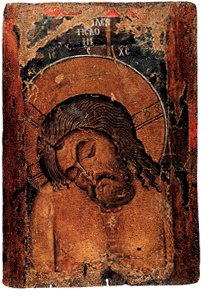
Christ in the Tomb

A Prayer for Holy Saturday

O faithful, come, let us behold our Life laid in a tomb to give life to those who dwell in tombs. Come, let us behold him in his sleep and cry out to him with the voice of the prophets: 'You are like a lion. Who shall arouse you, O King? Rise by your own power, O you who have given yourself up for us, O Lover of mankind.'

We await the Great Vigil.

Wednesday, March 12, 2008

On Choosing a Church

I read a wonderful bit of wisdom on Amy Welborn's blog today. Marcel Lejeune shared this on a comment thread:
A friend recently asked me what I “need from the Church”. My response boiled down to - I need the Church to make saints. Not in naming someone a saint, but rather in calling us all to holiness and perfection. Making modern-day saints out of the ordinary. We have a crisis in holiness in the Church. Holiness would solve every problem.
There is a great temptation to think about the work of the Church (caring, healing, celebrating and teaching) as equivalent to some kind of service industry or retail job. At the bookstore, I want the place, and particularly my religion section, to be the kind of place to which people will want to come and spend time and buy books. There is a needful and legitimate extent to which I have to think about what people want, and try to have that on offer. It's my job to sell books, and other concerns are secondary. I do have the opportunity to serve in some creative ways: there are a number of books in Joseph-Beth's selection that I make sure we carry, and do indeed sell, that you're not going to find in other places, and that we wouldn't have if I didn't put them there. If you want them, you will come into the shop and find good Christian books that are good for you. It will not be hard to find them. This is not true at chain stores or Christian bookstores (depending, of course, on who you trust to declare something "good.") Of course, you will also find Joel Osteen's stuff. I work for a "secular" business, not a confessional one. I don't go out of my way to get book that I think are bad for people just because I think they'll sell. But I don't try to prevent the stocking of titles that already sell. And of course if I'm indifferent about a title, I want to carry it if it will sell.

The work of the Church ought not to follow the same logic, however. "Give the people what they want" is a sound business practice and marketing strategy, but it is deadly to the life of any church that seeks to organize itself in such a fashion. The shape of the liturgy is not decided by popular vote, and we must not be interested in doing things because they are "neat." The Church has a reason to exist that comes before anybody else's agenda: it is the People of God, the new humanity that has been created in Jesus Christ to worship the Father along with Him, and to participate in the renewal of Creation in the power of the Spirit.

The Church doesn't exist in order to bring a large number to its Sunday gatherings for any reason, or to be "useful" in the social order or to split up responsibilities for poor folks with the government. The Church is called to give people Christ through the Sacraments, and Christ through their own presence in the dark and broken places of human life. The Church is called to mimic and extend Jesus' own ministry of healing, teaching, meal sharing and exorcism. That can look like all kinds of things, but the Church is not at liberty to make up activities unrelated to those things, and call it "ministry."

This is why it is dangerous to choose which group of Christians you'll make your life with on the basis of musical tastes, your "enjoyment" of the "worship experience," or the activities they put on offer. In most cases, those things will have very little to do with whether you can find healing and wholeness in Jesus Christ along with that community, or whether they are a people who can or will come alongside you to stay in the dark places of your life.

We need to be involved in communities that will participate actively in God's work of making us all saints - bringing us all to completion of who we really are.

Wednesday, March 05, 2008

Christian Worship Lingo

I had a good conversation with a friend yesterday about the teaching implicit in different liturgical styles. For example, in some churches, the "worship band" is illumined by stage lights in an otherwise dark auditorium. In the context of Christian worship, the implication is that the band are objects of veneration.

Seriously. Otherwise, why would it be important to see them? This is improper, and you should all stop it at once.

In other congregations, however, the worship band/music team/whathaveyou doesn't have a script. They don't talk. The entire congregation has a script it follows as it learns to talk to God the Father along with Jesus, who is the real "lead worshipper."

And of course, when my own parish meets in a place with fancy lights, we illumine the altar, because that is the dramatic focus of the entire movement. And yes, you may venerate it if you wish.

Saturday, February 16, 2008

Just for fun

Of course, sometime in the next 5 years, I'm thinking about planting a new Anglican parish in Georgetown, Kentucky, to bring the Catholic religion to that poor benighted land. Now, you may be aware that it is traditional for protestant groups to name their communities after numbers, or the streets along which the meetinghouse sits, or something that shows good marketing sense while resonating with the language of Scripture (e.g. "New Hope" or "Living Water, and so on). The Catholic churches (Rome, Canterbury, and the East) will often name their communities for notable saints, or events in the life of Christ. While there's not a hard and fast rule, many hardcore Anglo-Catholic churches will pick the latter option. For example, Church of the Advent in Boston is so "high up the candle" that the local Roman Catholic Archbishop gets a nosebleed when he passes on the street.

While I might have fled to the Church of the Holy Hierarchical Authoritarianism, I've got enough tra-la-la tree-hugging namby-pamby egalitarianism in me that I'd probably go in and start the "Georgetown Anglican Fellowship," and then when we numbered around a dozen, start discerning an appropriate name/patron/commemoration for the parish. But just for fun, here are my top five name choices for a new parish I'd like to start, somewhat in order.

  1. Saint Clement of Rome. We have one document extant from this early leader of the Roman Church, his Epistle to the Corinthians in which he lovingly chides them for their disunity. The community had recently overthrown their college of presbyters and apparently brought in some upstarts to replace them. I've written on the Epistle here. I believe that American Anglicanism has an ecumenical and unifying mission in the life of the Church as it seeks to live and share the Gospel, and looking to Clement and his writing as an example would be good for a young parish.

  2. Saint Mary Magdalene. Mary is known for her loving dedication to the Christ who exercised and healed her of demonic oppression. In a neurotic, materialistic suburban culture, we need this model. Also, this is the name of a famously exuberant Anglo-Catholic parish in Oxford. Which is braggable. Heh.

  3. Church of the Resurrection. This really shouldn't need any explanation at all. We need Jesus Christ, the second Adam, to heal us and make us alive.

  4. Saint Cyprian of Carthage. Haha, not really. I just wanted to see who was paying attention.

  5. Church of the Incarnation. Take that, latent gnosticism! Meditation on the Incarnation will guide us to sacramental and catholic imagination, to understand that matter can and does bear the glory of God.
What do you think?

Monday, February 11, 2008

Why Ecclesiology is a Rough Subject

As soon as one decides that the nature of the Church is a first-order rather than a second order question (see here), things begin to get very difficult. One can no longer say that the constitution, identity and practices of different Christian communities amount to a matter of preference. If one believes that one's life in the Christian community (what kind of life, and what kind of community) will impact the nature or extent of one's connectedness to Jesus, then comments like, "I go to x church because I like the music and you go to y church because you like the education program ceases to make any sense. Preferences, no matter how fastidious or well-meaning they are, are not the reason for the Church's existence.

For better or worse, I always need a reason.

I find that when I am no long prepared to speak about preferences as a theological category, I quickly have to start pinning down what the concrete attributes are of those concrete communities that are connected to those communities started by Jesus. As I work these things out, I find a two-edged sword.

1) If I really get hardcore about this, I'll have to face up to the real and potential inadequacies of my own (adopted) tradition. The Roman, Eastern Orthodox, and Reformed Christian traditions all have particular criticisms of what Anglicanism would seek to be, even at its best. I have to do business with those criticisms, and I might well find my "spiritual home" lacking.

2) In the same way, if I were to write about this journey, I would have to admit the ways in which I believe other Christian traditions to be lacking. I've not often been shy about this, but I don't believe that it's necessarily an edifying discussion to have. Surprise, even the folks to look to me for encouragement or challenge in the Faith (in this space or otherwise) are not eagerly awaiting any pronouncements on which churches are real churches. I'd probably end up sounding like the Pope, but with different conclusions, i.e., the requirements for being understood as fully and properly "the Church" are ABCD, and while it's nice that you've got BCDE over there, if you don't have A, you're Christians but don't experience the life of the Church in its fullness. I suspect the Holy Father and I would just pick different letters.

I might talk about what I think those letters consist of later on, or I might not. We'll see.

Wednesday, February 06, 2008

Lenten Antics

Kitty is covered in soot and hissing at his bowl of kibble.

He hates fast days.

Sex in the Church: A Glossary

The rhetoric of the culture wars has made it increasingly clear that many Christians and Christian denominations lack a theology of marriage. Just pick up the paper or turn on the television, and you can uncover all kinds of contradictory rationales as to how marriage ought or ought not be defined - and indeed, who should define it. I remember when George W. Bush announced to the nation that "marriage is a sacrament;" I wondered if he was making the statement in his capacity as the President of the United States, or as a United Methodist layman.

Amusingly, many Christians don't know how to talk about not having sex, either. With this in mind, I'm going to draw out the meaning of three distinct words that are often used interchangeably in Christian circles: abstinence, chastity and celibacy.

Abstinence is the state of refraining from sexual relations. Some people are abstinent by choice, and others by commitment - it's a very broad and general word. This is not the same as chastity or celibacy. Married people might practice abstinence during a period of fasting, or single people who are dating but not "hooking up" could be called abstinent. It's the answer to a yes or no question, and is not indicative of an overall lifestyle choice, while the other words are.

Chastity is a Christian virtue. Those who are chaste engage in sexual relationships only within the boundaries offered by a Christian moral vision. For married people, that means they only engage in sexual relations with one another. For those who are not married, this means not engaging in sexual congress at all. Chastity is a Christian obligation for all baptized persons, whether they are single or married.

Celibacy is a vowed state, as marriage is a vowed state. An unmarried Christian person who practices abstinence is not considered celibate - rather, they are chaste. Vowed or not, in a Christian context celibates are people who have closed the door to the possibility of marriage in response to a call from God. Therefore, while a chaste single Christian might go on a date, a celibate Christian would not. Celibacy and marriage are like bookends in the life of the Church. They are alternative states of life that are protected by vows to which Christians seek to be faithful.

Does that clear some things up?